
Before the modern era, the records of Norwegian life were kept by the Lutheran state church, and its church books (kirkebøker) are the backbone of Norwegian genealogy. Recording baptisms, confirmations, marriages and burials, often back to the 1600s and 1700s, and freely available on the Digital Archives, they are where most Norwegian family history is done. This guide explains what they contain and how to use them.
What the church books are
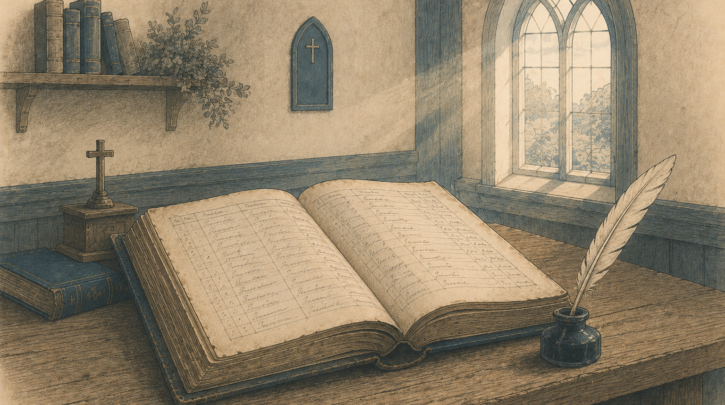
As the established church of Norway, the Lutheran Church was responsible for recording the key events of every parishioner’s life, and its ministers kept parish registers of them. The oldest surviving Norwegian church books date to the 1600s, though coverage becomes more consistent through the 1700s, and from 1812 a standardised printed format with columns was introduced, making later records especially clear to read. These registers, kept parish by parish, are the primary source for tracing a Norwegian family before the twentieth century.
Not sure where to start with your Norwegian ancestry?
Get the Norwegian Genealogy Quick-Start Checklist — a 5-step path to your first real ancestor record, plus the naming quirk that trips up almost everyone at first.
The events they record
Norwegian church books record the sacraments and rites of life, each useful to the genealogist:
- Baptisms (dåp) — the child, the parents, and the godparents (faddere), who were often relatives.
- Confirmations (konfirmasjon) — young people confirmed around age 14–15, an almost universal rite (see below).
- Marriages (vielser), often with betrothal or banns, naming the couple and sometimes their fathers.
- Burials (begravelser), naming the deceased and often their age.
Why confirmation records are gold
A special word for confirmation records, which are unusually valuable in Norway. Because confirmation in the Lutheran church was near-universal—almost every young person was confirmed, around age 14 or 15—the confirmation registers effectively list an entire age cohort of a parish, with names, ages and often the farm and parents. This makes them a superb finding aid: a young person who is hard to locate in the baptism records can often be found at confirmation, which then points back to their birth. Norwegian researchers lean on confirmations heavily, and you should too.
Migration lists
Many Norwegian church books also record migration into and out of the parish (inn- og utflyttede)—people moving to or from other parishes, and, valuably, those emigrating. These lists can track a family’s movements between parishes (essential when a farm name changes with a move) and can even document an ancestor’s departure for America, providing a bridge to the emigration records. Watching for these entries can solve the puzzle of where a family went—or came from.
Norwegian church books are digitised and free on the Digital Archives. Access them via the records hub, and pair them with the censuses.
Reading and using them
To trace a family through the church books, work backward from a known point—often a census entry placing the family on a farm—and use the parish’s registers to find the baptisms, confirmations, marriages and burials. Because the older books are in an older hand and in Danish, expect a little practice at first, easing greatly with the clearer post-1812 format. Confirm each family by matching the parents’ names, the farm and the dates, remembering that the farm name may change as a family moves.
Coverage and its limits
The church books are rich but not uniform. Coverage varies by parish and thins the further back you go: a register may begin late, have gaps, or be missing, and the earliest books can be brief. Some events may be under-recorded, and a family that moved between parishes must be followed across more than one set of registers. Where the church books fall short, Norway’s other records—the censuses, probate records and the bygdebok—fill the gaps, and together they make Norwegian research remarkably complete.
The parish structure behind the books
To use the church books well, it helps to understand the church structure that produced them. Norway was divided into clerical districts (prestegjeld), each often containing several parishes (sogn), served by a minister who kept the registers. A family’s records will be found in the book for their particular parish, so knowing not just the region but the specific parish is what lets you open the right register. When a family lived near a parish boundary, or moved, their records may be split across neighbouring parishes’ books, so be prepared to check more than one. Understanding this geography turns the church books from an undifferentiated mass into a precise, navigable system, and it is why establishing the parish is such an early priority in Norwegian research.