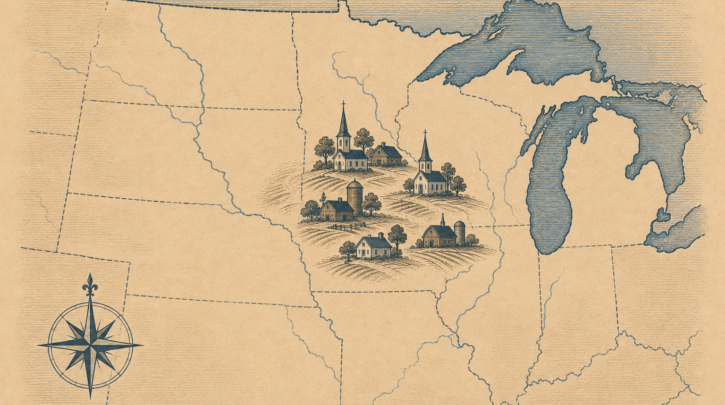

Norwegian emigrants did not scatter randomly across America—they concentrated, to a remarkable degree, in the Upper Midwest, and within it they clustered by their Norwegian home district. Knowing where Norwegians settled is more than context: because emigrants from the same valley settled together, these patterns are a genuine research tool for tracing your family back across the ocean. This guide maps the main Norwegian-American communities and how they help you.
Wisconsin: the first settlements
The first major Norwegian settlements in America grew up in Wisconsin in the 1840s. Communities such as Muskego and Koshkonong became early centres of Norwegian America—destinations for new emigrants, founts of America letters home, and springboards for further settlement west. Wisconsin’s early Norwegian colonies established the pattern of Norwegian Midwestern life: farming communities anchored by Lutheran churches, tied closely to specific home districts in Norway. For families who emigrated early, Wisconsin is often the first American home, and its early Norwegian settlements are well documented.
Not sure where to start with your Norwegian ancestry?
Get the Norwegian Genealogy Quick-Start Checklist — a 5-step path to your first real ancestor record, plus the naming quirk that trips up almost everyone at first.
Minnesota: the heartland
If Norwegian America has a heartland, it is Minnesota, which drew more Norwegian settlers than any other state and became synonymous with Norwegian-American identity. Norwegians spread across Minnesota’s farmland, founding countless rural communities and shaping the character of whole regions of the state. The density of Norwegian settlement in Minnesota—its churches, its bygdelag, its enduring traditions—makes it central to Norwegian-American research, and a great many Norwegian-American families pass through Minnesota at some point in their story. For the researcher, Minnesota’s rich local and church records are invaluable.
Iowa and the Dakotas
Norwegian settlement spread south into Iowa and, especially in the later nineteenth century, west into the Dakotas. The opening of the Dakota plains to homesteading drew large numbers of Norwegians—many moving on from earlier settlements in Wisconsin and Minnesota, others coming directly from Norway—to take up free land under the Homestead Act. North Dakota in particular became heavily Norwegian, its prairie counties filled with Norwegian farming families. For families who emigrated in the peak decades of the 1880s and after, the Dakotas are often the destination, the last frontier of Norwegian agricultural settlement.
Illinois and the mother colony
Earlier in the story stands Illinois, home to the Fox River settlement founded in the 1830s by the pioneering Sloopers. As a “mother colony,” Fox River was a foothold from which Norwegians spread further into the Midwest and a destination that drew early emigrants. While Illinois did not become as heavily Norwegian as Minnesota or the Dakotas, its early settlement holds a special place in the story, and families with very early emigration may trace through the Fox River community that launched so much of Norwegian America.
The Pacific Northwest
Later Norwegian settlement reached the Pacific Northwest, especially Washington state, where Norwegians were drawn by fishing, logging and maritime work reminiscent of the Norwegian coast. Seattle and the Puget Sound region developed notable Norwegian communities, and the coastal, seafaring character of the Northwest appealed to emigrants from Norway’s own fishing and coastal districts. For families who emigrated later, or who moved on from the Midwest, the Pacific Northwest is a significant secondary centre of Norwegian America, with its own communities and records.
Clustering by home district
The single most important feature of Norwegian settlement, for the researcher, is clustering by home district. Norwegians from a particular valley, fjord or region tended to settle together in America, so that specific Midwestern communities were effectively transplanted from specific Norwegian districts. This was reinforced by chain migration and by the bygdelag, associations organised by Norwegian home district. The practical consequence is powerful: if you can identify where the other Norwegians in your ancestor’s American community came from, you have a strong clue to your own family’s origin.
Using settlement patterns in research
To put this to work, study the community your ancestor settled in. Which Norwegian district did most of the local Norwegians come from? What origins recur in the Lutheran church records, the bygdelag membership, and the local histories? Which families did yours marry into or live beside, and where were they from? Local and county histories, church records and bygdelag materials often reveal these shared origins. Because Norwegian Americans clustered so tightly, the answer for your ancestor’s neighbours is frequently the answer for your ancestor too, making the geography of Norwegian America a path back to the specific Norwegian farm and parish.