
Of all the experiences a Norwegian heritage trip can offer, none rivals standing on the actual farm your family came from. This is Norway’s special gift to the heritage traveller: because Norwegians were named for their farms, and because those farms so often still exist under the same name, you can frequently find and visit the specific place your ancestors left—perhaps still worked, perhaps with buildings they knew. This guide shows you how to identify the farm, find it on the ground, and visit it respectfully and rewardingly.
Why the farm is visitable
The reason you can visit an ancestral Norwegian farm comes down to the farm-name system. A Norwegian farm (gård) was a named, enduring place, and your family carried its name; many of these farms have existed for centuries and still exist today, bearing the same name, often still farmed—sometimes by descendants of the same family. This continuity means the farm name in your family history is not an abstraction but a findable location. Few ancestries offer anything comparable; in Norway, the place your ancestors are named for is very often still there to be visited.
Not sure where to start with your Norwegian ancestry?
Get the Norwegian Genealogy Quick-Start Checklist — a 5-step path to your first real ancestor record, plus the naming quirk that trips up almost everyone at first.
Identify the farm through research
Visiting the farm begins, like everything in Norwegian genealogy, with research. Before you can find the farm, you must identify it precisely—its name, and crucially the parish and district it lies in, since many farms share common names. Trace your family through the free records to establish exactly which farm, in which parish, your ancestors lived on and left. The bygdebok is especially valuable here, often pinpointing the farm and its families precisely. This documentary work is what turns “a farm called Berg, somewhere” into a specific place you can drive to.
Locate it on the ground
Once you know the farm and parish, locate the farm geographically. Norwegian farms are documented places, findable through farm registers, historical and modern maps, and gazetteers of farm names, which can give you the farm’s location within its parish—and modern mapping tools then let you find it today. Because farm names persist on the land and in addresses, a well-researched farm can usually be pinpointed quite exactly. Local help is invaluable at this stage: the parish, the local history society, or a cousin in the district can confirm precisely where the farm lies and how to reach it.
Visit respectfully
A crucial point: an ancestral farm today is very often a private home or a working farm, belonging to people who may have no connection to your family. Approach with courtesy and respect. Wherever possible, make contact in advance—through the local history society, the parish, or relatives in the area—rather than simply appearing at someone’s door; Norwegians are frequently gracious about heritage visits when approached properly, and an arranged visit is far richer than an awkward one. Respect that this is someone’s home and livelihood, do not enter land or buildings uninvited, and let local intermediaries help arrange a welcome. Handled well, such visits are a joy for everyone.
Pinpoint your farm before you go. The bygdebok and the free Digital Archives are the tools to identify exactly which farm and parish—start with the research guide.
What you’ll find there
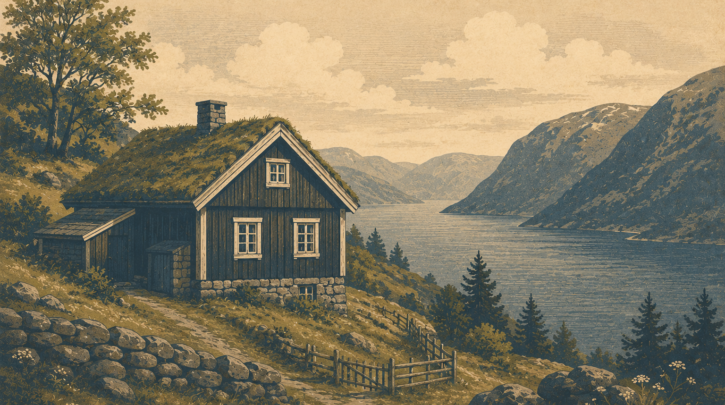
What awaits at the farm varies, and it helps to have gentle expectations. You may find the original farmhouse and buildings, or newer ones on the same ground; you will certainly find the landscape—the fields, the slopes, the water, the mountains—that your ancestors lived among, and which may look much as it did in their day. Nearby will usually be the parish church where they worshipped and the churchyard where they may be buried. Even where the buildings have changed, the place itself—the land, the setting, the view your ancestors woke to—is profoundly moving to stand within, a tangible link across the generations and the ocean.
Connect with people there
The farm visit is at its richest when it includes people. The current occupants, if welcoming, may know the farm’s history; the local history society will know the district deeply; and any cousins you have identified in the area can share the family’s places and stories. These local connections turn a visit to a place into a meeting with a living community that still holds the farm’s memory. Cultivating them before you travel—by correspondence, through the bygdelag or local society—is what most often transforms a farm visit from a quiet look at a field into a genuine homecoming.
A moment worth the journey
To stand at last on your ancestral farm—to see the land your family worked, touch the buildings or the stones they knew, visit their graves in the churchyard, and perhaps be shown it all by a cousin who still lives there—is, for many descendants, the single most moving moment of their entire journey into family history. It is the point where the whole endeavour—the records, the surnames, the emigration story—comes to rest in a real place you can hold in memory forever. Do the research, prepare the visit with care and respect, and let the farm your family left generations ago welcome you back.