
For Norwegian emigrants, one destination overwhelmingly dominated: the United States. Of the roughly 800,000 Norwegians who emigrated between 1825 and 1925, the great majority crossed the Atlantic to America, and above all to the farming country of the Upper Midwest. If your Norwegian ancestor emigrated, they almost certainly went to the United States. This guide traces that migration—its waves, its routes and its character—and shows how to research a Norwegian-American family.
America above all
Norwegian emigration was, to a remarkable degree, emigration to America. Unlike some European peoples who spread across many destinations, Norwegians overwhelmingly chose the United States, drawn by its abundant land and by the powerful pull of established Norwegian communities and the America letters. This concentration means that Norwegian-American research is, for most families, simply Norwegian emigration research, and that the rich records and strong community institutions of Norwegian America—its churches, its bygdelag, its local histories—are available to help trace almost any emigrant family back across the ocean.
Not sure where to start with your Norwegian ancestry?
Get the Norwegian Genealogy Quick-Start Checklist — a 5-step path to your first real ancestor record, plus the naming quirk that trips up almost everyone at first.
The waves of migration
The migration came in distinct waves. It began with the Sloopers of 1825 and a thin trickle through the 1830s and 1840s, when the first Midwest settlements took root. From the 1860s it swelled into a mass movement, reaching its greatest height in the 1880s, the single largest decade of Norwegian emigration, and surging again around 1900 to 1910. It declined in the 1920s as American immigration quotas took effect and conditions in Norway improved. Placing your family in one of these waves helps you anticipate the records available and the American communities they were likely to join.
The routes across the Atlantic
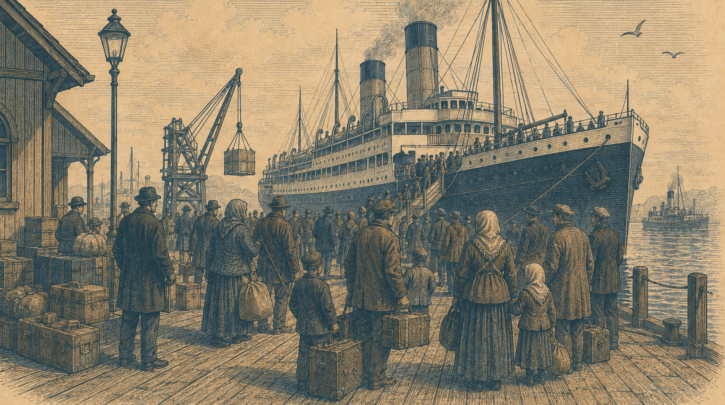
The journey itself changed over time. The earliest emigrants sailed on sailing ships, often on timber vessels bound for Quebec—a common early port of entry—from which they travelled overland and by the Great Lakes to the Midwest. Others sailed to New York. From the later nineteenth century, steamships transformed the crossing, and many emigrants travelled indirectly via British ports, typically taking a ship from a Norwegian port to Hull, crossing England by rail to Liverpool, and there boarding a transatlantic steamer to New York. Knowing the likely route and era helps you find your ancestor in passenger and emigration records.
Why America drew them
America’s pull was, above all, land. For Norwegians shut out of landownership at home by a crowded, mountainous country, the fertile and cheap—or, under the Homestead Act, free—farmland of the Upper Midwest was transformative, offering the independent farm that Norway could not. Beyond land came wages, opportunity, and the presence of established Norwegian communities that eased the way. Together these made the United States not just a destination but the destination, the place where a Norwegian family’s hopes for land and a future could realistically be met.
The Midwest heartland
Norwegian emigrants concentrated in the Upper Midwest to a striking degree—in Wisconsin, then above all Minnesota, and in Iowa and the Dakotas—where they took up farming and built dense, enduring Norwegian communities. The distinctive pattern of clustering by home district shaped this settlement, so that particular Norwegian valleys effectively transplanted themselves to particular Midwestern counties. We explore this geography, and how it helps the researcher, in Norwegian settlement in the Midwest—it is one of the keys to tracing a family back to its Norwegian home.
Community and identity
Norwegian America was held together by strong institutions that both eased assimilation and preserved identity: Lutheran churches at the centre of community life, the bygdelag organised by Norwegian home district, later the Sons of Norway, and the enduring celebration of syttende mai. These institutions kept the language, the customs, and—valuably for the genealogist—ties to specific home districts, generating records that can help trace a family’s origins. We look at this fuller story in the diaspora and assimilation.
Researching a Norwegian-American family
Tracing a family that emigrated to America follows a clear path. Work back through American records—censuses, naturalisation papers, church records, county and local histories—to identify the immigrant and, ideally, their Norwegian origin, watching especially for the farm-name surname that so often points to the home place. Then cross to the Norwegian records—the police emigration lists, the church books, the bygdebøker—to continue. The strong records on both sides, and the tight community clustering, make the crucial link back to a specific Norwegian farm genuinely recoverable, as detailed in finding your emigrant ancestor.