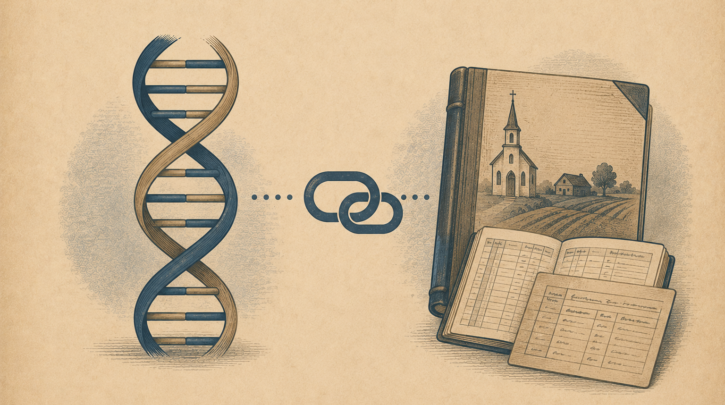

A DNA test on its own is a box of loose pieces: a list of matches, an approximate ethnicity estimate, a scattering of shared segments. It becomes family history only when you connect it to the documentary record—and here Norwegian research is fortunate, because Norway’s superb, largely free records are ideal partners for DNA. This guide shows how to turn your DNA results into a documented Norwegian family tree, and even use them to find the ancestral farm.
DNA finds cousins; records build the tree
Start from the right division of labour. Your DNA test finds genetic relatives and can confirm that a connection exists; the records establish exactly how you are related and carry the line back through the generations. DNA might tell you that a stranger shares enough DNA to be, say, a third cousin; only the records can show that you both descend from a particular couple on a particular Norwegian farm. Neither does the job alone. The whole art of genetic genealogy is using the two together—matches to point the way, records to prove and extend the connections—so treat every promising match as a research lead into the documents.
Not sure where to start with your Norwegian ancestry?
Get the Norwegian Genealogy Quick-Start Checklist — a 5-step path to your first real ancestor record, plus the naming quirk that trips up almost everyone at first.
Working with your matches
Your match list is the heart of the test’s value. Focus on your closer matches first, and examine any family trees they have attached, looking for shared surnames, Norwegian places, and ancestors in common. When you find a match who shares a Norwegian ancestral line, you can compare notes, pool what each of you knows, and often extend both trees. Matches who have already traced their line to a specific farm and parish are especially valuable—they may hand you the very origin you have been seeking. Reaching out courteously to promising matches is one of the most productive things you can do.
Confirming your paper trail
DNA is powerful for confirming the family history you have built on paper. If your documentary research says you descend from a particular Norwegian couple, then finding DNA matches who independently descend from that same couple—through different children—is strong evidence that your paper trail is correct. Conversely, an absence of expected matches, or matches that do not fit, can flag an error to investigate. Used this way, DNA is a check on the records and the records a check on the DNA, each strengthening your confidence in the other and catching mistakes that either alone might miss.
Breaking through brick walls
DNA can break brick walls that records alone cannot. When a paper trail stops—an unknown parent, an emigrant whose origin is lost—your DNA matches may descend from the very family you cannot document, and identifying the ancestor you share with a cluster of matches can reveal the connection the records concealed. This is especially valuable for the classic Norwegian-American wall: an immigrant whose home farm and parish is unknown. Matches who do know their Norwegian origin, and who share DNA with you, can point straight to the district—a modern key to an old problem.
Using DNA to find the farm
This leads to one of the most exciting uses of DNA in Norwegian research: finding the ancestral farm. Because Norwegian settlement and DNA both cluster by home district, a group of matches who trace to the same Norwegian farm or parish can pinpoint where your shared family came from—even when your own paper trail had lost it. Combined with the emigrant records and the community’s clustering, DNA matches can complete the crossing back to Norway, delivering the specific farm that then unlocks the deep church books and bygdebøker.
Turn your matches into a documented tree using Norway’s free records. Start at the Digital Archives and the records hub—and see current DNA kits on the DNA hub.
Autosomal reach and Y-DNA depth
Understand what each kind of DNA can reach. The autosomal test behind AncestryDNA and MyHeritage is excellent for finding relatives within roughly the last five or six generations, but its usefulness fades further back as shared DNA thins—so it connects you to cousins across the emigration era, but cannot reach your deep medieval ancestry. For a specific deep paternal line—a patronymic or farm line traced through fathers—Y-DNA reaches much further back along that single line. Matching the type of test to your question keeps your expectations realistic and your research efficient.
DNA plus the free records
The happy conclusion for Norwegian research is that DNA and Norway’s free records make an outstanding partnership. Your matches point you toward families, districts and farms; the free Digital Archives, the church books, the censuses and the bygdebøker then let you document the connections in full, at little or no cost. Few ancestries offer so rich a combination of genetic tools and free records. And remember, as ever, that what DNA reveals is heritage, not citizenship—a family history to treasure and, perhaps, to follow home on a heritage trip to the farm your DNA and the records together revealed.