
Many people planning a Norwegian heritage trip imagine days in dusty archives, poring over original registers. Here is a liberating truth: for Norwegian research, you usually do not need to visit an archive in person at all. So much of Norway’s documentary heritage is digitised and free online that most research can be done from home—which means your precious time in Norway is better spent on the farm, the parish and the landscape. This guide explains when an archive visit genuinely helps, and when it is happily unnecessary.
Most records are free online
The reason an archive visit is rarely necessary is the Digital Archives (Digitalarkivet). Run by the National Archives of Norway, it puts an enormous quantity of records—church books, censuses, probate records and much more—online, free, accessible from anywhere in the world. For a great many families, everything needed to trace the line back for generations is already available at no cost, from your own home. This is one of the great advantages of Norwegian genealogy, and it fundamentally changes what an in-person archive visit is for: not routine research, but specific needs and experiences.
Not sure where to start with your Norwegian ancestry?
Get the Norwegian Genealogy Quick-Start Checklist — a 5-step path to your first real ancestor record, plus the naming quirk that trips up almost everyone at first.
Do your research before you travel
The practical consequence is clear: do your research before you travel. Rather than planning to “find your family in the archives” once in Norway, trace them from home using the free online records, arriving with your genealogy already done and your farm and parish identified. This is not only more efficient—it is what makes the rest of the trip possible, since you must know where the farm is before you can visit it. Save the archives for the rare document that is not online, and spend your Norwegian days where the online records cannot take you: on the ground your family walked.
When an in-person visit helps
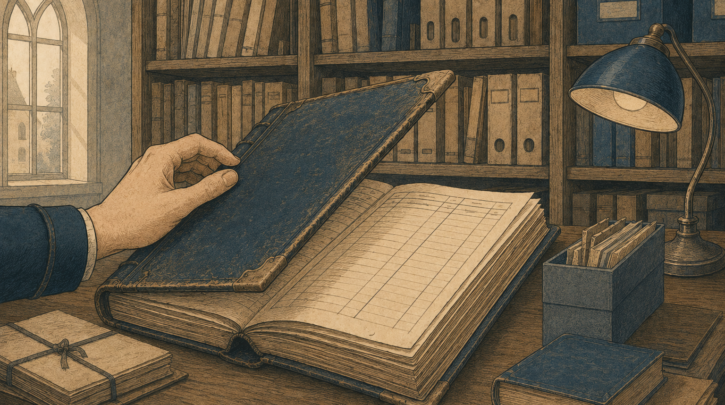
That said, an in-person archive visit can genuinely help in certain cases. Some records are not yet digitised, and for these the archive that holds them—or a local archive or library—may be the only way to see them. Certain specialised or local records, and some bygdebøker or local-history materials, live in regional and local repositories rather than online. And for some researchers, seeing and handling original documents, or consulting expert archivists, has real value. If your research has hit a specific need that the online records cannot meet, an in-person visit may be worthwhile—but identify that need first, rather than assuming a general archive visit is required.
The regional state archives
Norway’s archival system, beyond the online Digital Archives, includes the National Archives and a network of regional state archives (statsarkiv) across the country, which hold the original records for their regions. If you do need an in-person visit for un-digitised material, the relevant regional state archive is usually where those records live. Should you plan such a visit, prepare thoroughly: identify exactly which records you need and where they are held, check the archive’s access rules and opening hours in advance, and come with specific questions. A focused visit for a defined need is productive; a hopeful browse is rarely a good use of limited travel time.
Do your research from home for free before you go. The Digital Archives hold most of what you need—see the records hub to get started.
Preparing for a visit
If you do decide an archive visit is worthwhile, a little preparation makes it count. Know precisely what you are looking for and confirm the holding archive has it; check opening times, appointment requirements and any rules on access or handling; and consider whether a language barrier means you should prepare key Norwegian terms or seek help. Bring your existing research so you can place any new find in context. The more specific and prepared you are, the more a visit yields—and the less you risk spending a rare day in Norway on records you could have viewed free from your sofa at home.
The honest bottom line
The honest bottom line is that Norwegian archives in person are, for most heritage travellers, optional—and often unnecessary. Norway’s superb free online records mean you can and should do your research from home, arriving in Norway with your family already traced and your farm already found. Reserve any in-person archive visit for a genuine, specific need, and otherwise spend your time in Norway on what the internet cannot give you: the ancestral farm, the parish church, the landscape, and the living relatives. That is where the true reward of a Norwegian heritage trip lies—not in the archive, but in the homeland itself.