
The obstacle that stops many people tracing Norwegian ancestry before the modern era is the records themselves: an unfamiliar Gothic handwriting, and a language that is not quite modern Norwegian but Danish. It is a smaller barrier than it looks. Norwegian records are largely formulaic, so you are not translating free prose but recognising a fixed set of words in a predictable structure. Learn a few dozen terms and the shape of each record, and you can read most of what you will meet. Here is how.
Why the records are in Danish
A fact that surprises many newcomers: older Norwegian records are written in Danish, not Norwegian. Norway was in a union with Denmark until 1814, and Danish remained the written language of church and state well into the nineteenth century, so the church books, probate records and other documents you will read are in Danish (or a Dano-Norwegian close to it). For the genealogist this is quite manageable—the vocabulary you need is small and repetitive—but it explains why the words may look a little different from modern Norwegian.
Not sure where to start with your Norwegian ancestry?
Get the Norwegian Genealogy Quick-Start Checklist — a 5-step path to your first real ancestor record, plus the naming quirk that trips up almost everyone at first.
The Gothic handwriting
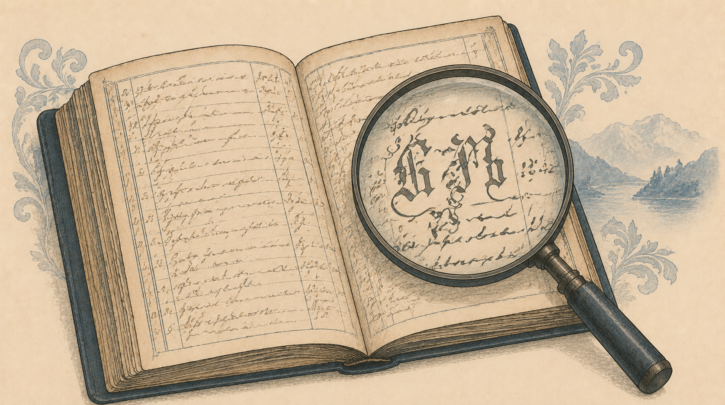
Older Norwegian records are written in an older Gothic cursive (gotisk skrift, sometimes called Kurrent) that takes some acclimatisation. Letters are formed differently from modern writing, several are easily confused at first, and abbreviations are common. But the hand becomes familiar with practice, and—crucially—because the records are formulaic, context tells you what a word should be before you can fully read it. The standardised post-1812 church-book format, with its labelled columns, is much easier than the free-form earlier books, so beginning with later records builds confidence.
Old spelling and orthography
Expect variable, archaic spelling. Danish-Norwegian orthography of past centuries was not standardised, so names and words appear in several forms—a given name or farm name may be spelled differently from one entry to the next, and letters are used in ways that differ from modern norms. Do not be thrown when your ancestor’s name is spelled three ways in three records; this is normal, and you learn to recognise the variants of the common names and words. Reading by sound, and comparing spellings across entries, resolves most difficulties.
Key terms worth knowing
A small vocabulary carries you far in Norwegian records. Beyond the event words—dåp (baptism), konfirmasjon (confirmation), vielse (marriage), begravelse (burial)—you will meet:
- sønn (son), datter (daughter), barn (child), fader/moder (father/mother).
- gård (farm), sogn (parish), faddere (godparents), enke/enkemann (widow/widower).
- skifte (probate), arving (heir), døde (died), født (born).
Keeping a short glossary of these beside you makes the records readable at a glance.
Practice on real records—start with your own family’s. Access them free via the Digital Archives; everything is on the records hub.
Working through your first record
The fastest way to learn is to decode one complete record slowly. Take a single baptism from your parish on the Digital Archives, identify the fixed, formulaic parts, and then isolate the handwritten details: the date, the child’s name, the parents (with their patronymics and farm), the godparents. Look up any word you cannot place. By the time you have fully understood one entry, you will recognise the structure in every other entry of the same type, and the reading gets rapidly easier.
Building the skill
Reading old Norwegian records is a skill that compounds quickly. A few habits speed it: read in context, letting the fixed format tell you what to expect; build a personal list of the Danish terms and the older spellings you meet; compare names across records to resolve ambiguous letters; and pair this with an understanding of Norwegian naming, so you can anticipate the patronymics and farm names. Lean, too, on the letter charts, glossaries and the active Norwegian and Norwegian-American genealogy communities online. Within a few afternoons’ practice, most people find they can read their ancestors’ baptisms and probate records in the original—a deeply rewarding skill that unlocks the richest records of all.
Aids that make it easier
You need not learn to read old Norwegian records unaided, and a few aids make the process far quicker. Letter charts for the Gothic hand—showing how each letter was formed—let you decode unfamiliar characters, while glossaries of Danish-Norwegian genealogical terms translate the recurring vocabulary. The standardised, labelled columns of the post-1812 church books tell you what each entry field contains even before you read it. And the active Norwegian and Norwegian-American genealogy communities—online forums, societies and social-media groups—are generous in helping decipher a stubborn word or entry, often reading a tricky record for you within hours. Leaning on these aids, rather than struggling alone, turns the intimidating prospect of Gothic Danish handwriting into a skill you build steadily and even come to enjoy, one record at a time.