
Researching your Norwegian surname is part history lesson and part detective work—and in Norway it comes with a distinctive twist: names were so fluid, and common names so widely shared, that the surname itself proves far less about lineage than in many cultures. Done well, though, surname research reveals your name’s meaning and type, may point you toward the ancestral farm, and—grounded in the records—leads to the real family behind it. This guide gives you a practical, honest method for researching a Norwegian surname.
Step 1: Identify the type of name
Start by working out what kind of surname you have, because the type shapes what it can tell you. Is it a patronymic (a -sen or -son name like Hansen or Olson), naming an ancestor’s father? Or a farm name (like Berg, Haugen or Fjelstad), naming a place? This first distinction is the most important, and it is usually clear: -sen/-son endings mark patronymics, while landscape words—often ending in the definite-article -en—mark farm names. Our guide to Norwegian surname origins helps you place it. This step orients the whole search.
Not sure where to start with your Norwegian ancestry?
Get the Norwegian Genealogy Quick-Start Checklist — a 5-step path to your first real ancestor record, plus the naming quirk that trips up almost everyone at first.
Step 2: Set realistic expectations
Before diving into records, be clear about what the name can and cannot do. Because Norwegian surnames were fluid and the common ones are shared by countless unrelated families, your surname will rarely, on its own, identify a lineage or connect you to other bearers. What it can do is reveal its meaning and type, and—if it is a farm name—offer a real clue to a place of origin. Approaching surname research with this honest understanding, name as clue rather than proof, saves you from the false trails that trip up the unwary, especially with a common patronymic.
Step 3: Use a farm name to locate the origin
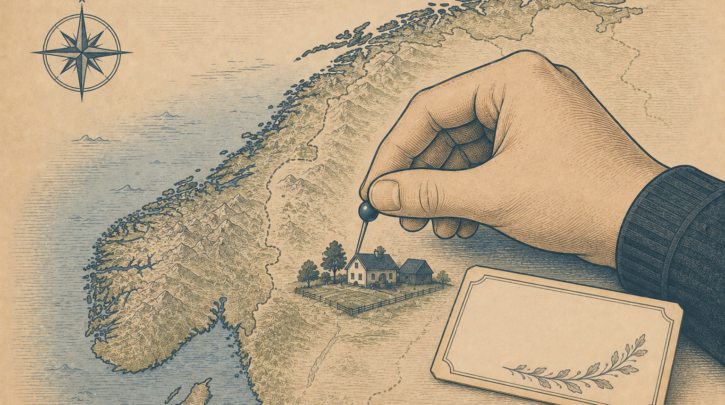
If your surname is a farm name, put it to work as a locating clue. A farm name is a place, so it may point toward the ancestral farm—a genuine advantage of Norwegian research. Search for the specific farm in the censuses and bygdebøker, which are organised by farm, bearing in mind that many farms share common names, so you must pair the farm name with a parish and region and confirm the specific farm in the records. The rarer the farm name, the stronger the clue; even a common one narrows the search once combined with other evidence.
Step 4: Reverse any American changes
For a Norwegian-American surname, reverse the changes it underwent on emigration to recover the original. Restore the Norwegian letters (o to ø, a or aa to å), convert a -son ending back to -sen, and consider whether the name is a frozen patronymic or a frozen farm name—the full process is set out in Norwegian surname changes in America. Testing the reconstructed Norwegian form against the records is often the step that reconnects an American family to Norway, so do not assume the American spelling is how the name will appear in the Norwegian sources.
Step 5: Trace the family through the records
The heart of Norwegian surname research is following the actual family through the documents, not the name. Trace your line back through the censuses and church books, always confirming you have your family by matching given names, the father’s name (from the patronymic), the farm, the parish and the dates—never by the surname alone, which may shift between records or represent a frozen choice. This documentary reconstruction is what turns a name’s general meaning into your specific, proven family history, and it is indispensable given how fluid and common Norwegian names are.
Step 6: Consider Y-DNA for a male line
For a focused question about a paternal line, Y-DNA testing can help, since the Y chromosome follows the strict male line. It can test whether two families sharing a surname—or suspected of a shared paternal origin—truly descend from a common male ancestor, something documents may not resolve, especially given how many unrelated families share a common Norwegian name. Y-DNA is a specialist tool rather than a first step, but for a surname mystery that the records leave open, it can add real evidence; see the options on the DNA hub.
Step 7: From surname to farm to heritage
Norwegian surname research often has a satisfying destination: the farm itself. Because a farm name is a real place, tracing a farm-name surname can lead you to a specific farm that may still exist and be visited—turning the research into the foundation of a heritage trip to the very ground your family came from. Even a patronymic, traced back through the records to the farms your family lived on, points to real places in Norway. In this way, understanding your surname is not just an academic exercise but the first step on a path that can lead, quite literally, home.
Bringing it together
Researching a Norwegian surname rewards understanding its special nature: that the name reveals meaning and type but rarely proves lineage, that a farm name may locate an origin, and that an American form must often be reversed to find the Norwegian original. Identify the type, set honest expectations, use a farm name as a locating clue, reverse any American changes, and above all trace and confirm the family group in the records. Pursued together and always grounded in evidence, these steps turn your Norwegian surname from a mere label into a thread leading back—through the church books and bygdebøker, and perhaps all the way to a farm you can stand on—to the real ancestors who first bore it.