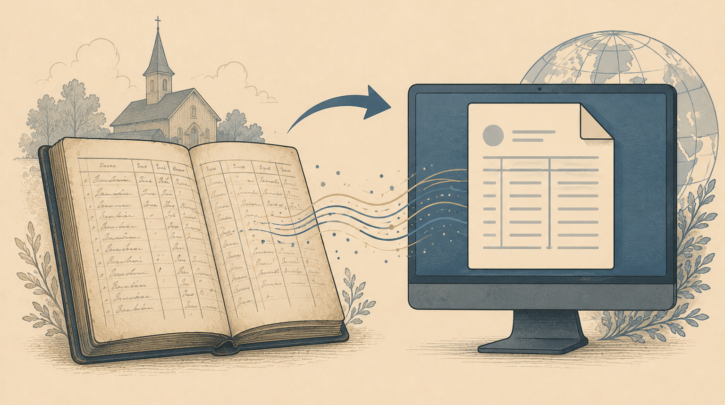

Here is the fact that shapes all Norwegian genealogy: an enormous quantity of Norway’s records has been digitised and made available completely free on Digitalarkivet (the Digital Archives), run by the National Archives of Norway (Arkivverket). For many families, the records you need can be viewed online at no cost, from anywhere in the world. Learning to use the Digital Archives well is therefore one of the most valuable skills in Norwegian research. This guide shows you how.
What the Digital Archives holds
The Digital Archives brings together a vast range of Norwegian records, and the collection is remarkable in scope:
- Censuses — the 1801, 1865, 1875, 1900, 1910 and other counts, searchable by name.
- Church books — the Lutheran kirkebøker, as digitised images and, increasingly, transcribed.
- Probate records — the skifter that name heirs.
- Emigration records — the lists that document departures for America, invaluable for the diaspora.
All of this is free to access—a genuinely extraordinary resource that puts much of Norway’s documentary heritage at your fingertips.
Not sure where to start with your Norwegian ancestry?
Get the Norwegian Genealogy Quick-Start Checklist — a 5-step path to your first real ancestor record, plus the naming quirk that trips up almost everyone at first.
Searchable versus scanned
It helps to understand that the Digital Archives offers records in two forms. Some—notably the censuses and a growing body of other records—are transcribed and searchable, so you can search by name, farm and place and jump to the entry. Others—much of the church books and probate material—are available as scanned images you browse yourself, by parish and year, exactly as you would the original register. So Norwegian research typically combines searching the transcribed censuses to locate a family, then browsing the scanned church books of their parish to find the baptisms and marriages—which is why knowing the parish matters so much.
Searching effectively
When searching the transcribed records, search flexibly, because Norwegian names and spellings vary greatly. Try patronymic variants (Olsen, Olsson, Olssøn), search by given name plus farm or parish, and use age and place to narrow results. Remember that the “surname” in a record is often a farm name that may differ from one record to the next, so searching by a fixed surname can mislead—combine given name, patronymic, farm and place instead.
A visit to the Digital Archives costs nothing and opens most of Norway’s records. Pair it with the bygdebok for family histories, and start with the step-by-step guide.
Browsing the scanned registers
For the scanned church books, the technique is to navigate to the register for your parish and year and read the entries as you would the original, watching for your family by the parents’ names and the farm. This takes more effort than a name search, but it is how much of the richest Norwegian material is accessed, and the post-1812 columnar format makes the later books quite readable. Record precisely which register, page and image you found each entry on, so you can cite and return to it.
Free, but know the gaps
The Digital Archives is a magnificent free resource, but not everything is there or transcribed. Some records remain only as images to browse, some are held by the regional state archives and not yet digitised, and the bygdebøker live largely elsewhere. But the sensible starting point is almost always the Digital Archives: it is free, vast, and available now, and for a great many Norwegian families it holds everything needed to trace the line back for generations—a resource that makes Norwegian genealogy among the most accessible in the world.
The regional state archives behind it
Behind the Digital Archives stands the wider Norwegian archival system, worth knowing for when the online material runs out. The National Archives (Arkivverket) includes a network of regional state archives (statsarkiv) across the country, which hold the original records for their regions—church books, probate protocols, court and land records and much more. A great deal of this has been digitised onto the Digital Archives, but not all, so where a record you need is not yet online, the relevant regional state archive is its home and can often provide access or copies. Knowing that the Digital Archives is the online face of a comprehensive national archival system reassures you that there is always somewhere to turn when the free online collections do not yet reach what you seek.