
Nothing puzzles newcomers to Norwegian genealogy more than the names. A man called Hansen whose father was not a Hansen; a family whose surname changes when they move to a new farm; children who share neither a fixed family name nor, seemingly, their parents’. Norwegian naming can seem baffling until you understand the system behind it—and understanding it is essential, because you cannot trace a Norwegian family by a fixed surname. This guide explains how Norwegian names worked and how to research around them.
Two elements: patronymic and farm
Traditional Norwegian naming combined two elements beyond the given name. First, a patronymic: a person was identified as their father’s child, with -sen (“son”) or -datter/-dotter (“daughter”) added to the father’s given name. Second, a farm name: the name of the farm (gård) where the person lived. So Ole Hansen Berg was Ole, son of Hans, living on the farm Berg. Understanding these two elements—and how each behaves—is the key to Norwegian names.
Not sure where to start with your Norwegian ancestry?
Get the Norwegian Genealogy Quick-Start Checklist — a 5-step path to your first real ancestor record, plus the naming quirk that trips up almost everyone at first.
How patronymics worked
The patronymic changed every generation, because it named the actual father. Hans Olsen’s son Ole would be Ole Hansen (Hans’s son); Ole’s son Hans would be Hans Olsen (Ole’s son); and so the -sen name alternates and shifts down the generations, never a fixed family surname. A daughter took -datter: Hans Olsen’s daughter Kari was Kari Hansdatter. This means that, in traditional Norwegian records, the patronymic tells you the father’s given name—a genealogical clue in itself—but is not a surname shared across the family.
How farm names worked—and changed
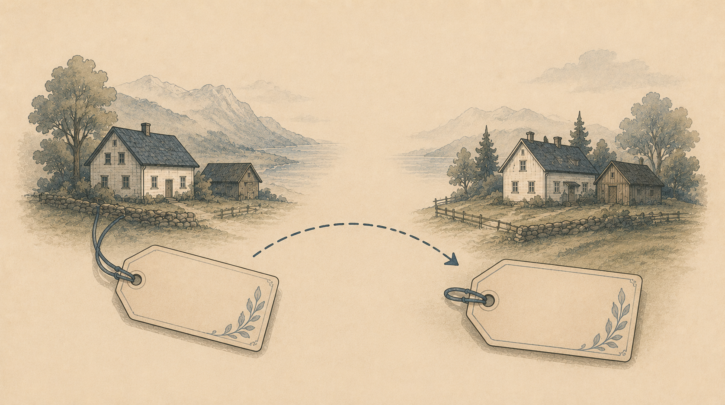
The farm name is where Norwegian naming most surprises the newcomer, because it changed when a family moved. A person was named for the farm they lived on at that time; if they moved to a different farm, their farm name changed accordingly. So Ole Hansen Berg, on moving from Berg farm to Dal farm, would become Ole Hansen Dal. The farm name, then, is not a hereditary surname but a kind of address—which means the same person can appear under different farm names at different points in their life, and members of one family living on different farms can carry different names.
The research consequence
The practical lesson is fundamental: in Norwegian genealogy, you cannot rely on a fixed surname to trace a family. Instead you identify and follow people by the whole cluster of evidence—the given name, the patronymic (which names the father), the farm (which locates them), the parish, and the dates. When a person’s farm name changes, you follow them by the constant elements—their given name, their patronymic, their known relationships—and by migration records that track the move. This reorientation, from surname to the patronymic-plus-farm-plus-place cluster, is the master skill of Norwegian research.
Because names shift, matching by patronymic, farm and parish is everything. See the method in how to trace Norwegian ancestry, and explore name meanings in Norwegian surname origins.
The shift to fixed surnames
Norwegian naming changed over time. Through the later nineteenth century, families increasingly began to fix a surname—often freezing either the patronymic (so a family became permanently Hansen) or the farm name (so a family became permanently Berg)—and Norway’s Names Act of 1923 ultimately required hereditary surnames. So a family that was fluidly patronymic-and-farm in 1850 had a fixed surname by the early twentieth century. Emigrants often fixed their name at emigration, which is why so many Norwegian-American surnames are frozen patronymics or farm names.
Turning the system into a tool
Once understood, Norwegian naming is less an obstacle than a source of clues. The patronymic hands you the father’s given name; the farm name locates the family in a specific place and time, and its change signals a move to trace; the whole pattern, read correctly, guides you through the generations. By abandoning the expectation of fixed surnames and embracing the patronymic-plus-farm method, you not only avoid the errors that trip up the unwary but read the names as the rich evidence they are. In Norwegian genealogy, the name is not a label to match but a small packet of information—father, place and time—waiting to be decoded.
Names in the records versus names in America
A practical tension worth anticipating is that a person’s name in the Norwegian records may look quite different from the fixed surname their descendants carry in America. In Norway, your ancestor might appear as Ole Hansen (patronymic) on one farm and Ole Hansen Berg or simply Ole Berg (farm name) elsewhere, shifting with each move and record. On emigrating, the family typically froze one form—the patronymic (becoming permanently Hanson/Hansen) or the farm name (becoming permanently Berg)—into a hereditary American surname, a process explored in Norwegian surname changes in America. Recognising which element your American surname preserves—a father’s name or a farm—is both a satisfying insight and a practical clue, since a frozen farm-name surname may point straight back to the ancestral farm you are trying to locate.