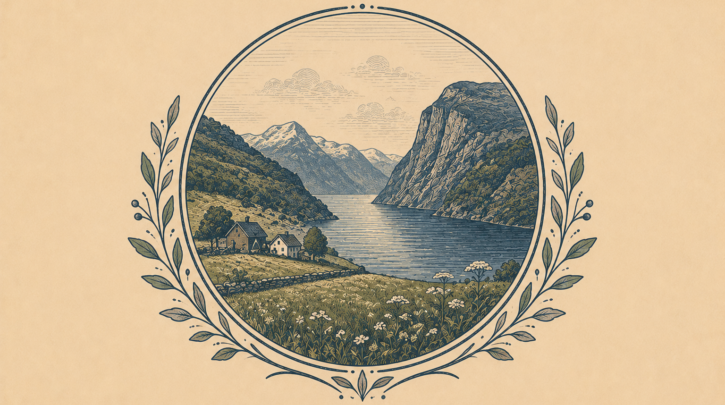

Alongside the patronymics stands the other great category of Norwegian surnames—and the more evocative one: the farm name (gårdsnavn). Drawn overwhelmingly from the landscape—the hills, valleys, shores and meadows of Norway—farm names describe the very ground a family lived on. Berg, Dahl, Haugen, Lie, Vik: these names paint a picture of the Norwegian countryside, and, distinctively, because a farm name is a place, it can sometimes point you toward a family’s origin. This guide explores Norway’s farm surnames and what they mean.
Names from the landscape
The great majority of Norwegian farm names come from nature and terrain, describing the location or features of the farm. Once you know the pattern, they are a delight to decode:
- Berg (hill, rock, mountain), Dahl / Dal (valley), Haugen (the mound or hill), Ås / Aas (ridge).
- Lie / Li (hillside, slope), Bakken (the slope), Moen (the meadow or plain), Eng (meadow).
- Vik (bay, inlet), Ness / Nes (headland, point), Strand (shore), Holm (islet).
- Lund (grove), Skog (forest), Rud (clearing), Sletten (the flat, the plain).
Each of these names locates a family in the Norwegian landscape—on a hillside, by a bay, in a valley—and their sheer frequency reflects how completely Norwegians drew their farm names from the land around them.
Not sure where to start with your Norwegian ancestry?
Get the Norwegian Genealogy Quick-Start Checklist — a 5-step path to your first real ancestor record, plus the naming quirk that trips up almost everyone at first.
The definite-article ending
Many Norwegian farm names carry a distinctive definite-article ending—the suffix -en (or -a)—which means “the.” So Haugen means “the mound,” Bakken “the slope,” Moen “the meadow.” This is why so many farm-name surnames end in -en: they are simply the landscape feature with “the” attached, as the farm was known locally. Recognising this ending helps you read a farm name—Haugen and Haug are essentially the same word with and without the article—and distinguishes farm names from the patronymic -sen ending, which looks similar but means something entirely different.
The farm name as a place
The defining feature of a farm name, and what makes it so interesting to the genealogist, is that it is a real place. Unlike a patronymic, which names a person, a farm name names a specific farm—a location you can, in theory, find on a map and even visit. This gives farm-name surnames a special quality: they tie a family not just to a naming tradition but to a piece of ground. For the researcher, and especially for the descendant planning a heritage trip, this is powerful, because the surname may name the very farm the family came from.
A clue to your origin
Because a farm name is a place, a farm-name surname can sometimes point toward a family’s origin—a genuine and valuable clue when you are hunting for the ancestral farm and parish. If your Norwegian-American surname is a farm name like Fjelstad, Sletten or Kvam, it may well be the name of the very farm your family left. This is one of the great advantages of Norwegian research over ancestries where the surname reveals no place at all: your name itself may be a signpost home, worth investigating early in the search.
The same-named-farms caution
There is, however, an important caution: many Norwegian farm names recur across the country. There are countless farms named Berg, Haugen, Dahl, Moen and Lie, scattered through every region—so a common farm-name surname does not, by itself, pin down a single location. A surname of Berg tells you the family lived on a farm called Berg, but not which Berg, of the many. So treat a farm-name surname as a lead to investigate, not a proven origin, and always confirm the specific farm through the records. The rarer and more distinctive the farm name, the more useful a locating clue it is.
Farm names in the emigrant’s name
The farm name takes on special importance in diaspora research because emigrants so often carried it. A Norwegian known by a patronymic and a farm name (Ole Hansen Berg) frequently froze the farm name as the family’s American surname—so a great many Norwegian-American surnames are farm names, pointing back to the ancestral farm. Sometimes the name was respelled or simplified in America, as we discuss in Norwegian surname changes in America. Recognising that your surname is a farm name, and identifying the specific farm, can be the key that unlocks the crossing back to Norway, as explored in finding your emigrant ancestor.
Researching a farm surname
To research a farm-name surname, first decode its meaning—which feature of landscape or place it names—and then treat it as a possible pointer to the ancestral farm, to be confirmed rather than assumed. Search for the specific farm in the censuses and bygdebøker, which are organised by farm, and pair the farm name with a parish and region to distinguish it from its same-named cousins. Understood as a window onto the Norwegian landscape and, often, a signpost toward a specific farm, the farm-name surname is among the most charming and useful of Norwegian names—a reminder that your family took its name from the very land of Norway, land you may one day stand on.