
Among the most useful—and most accessible—of all Norwegian records are the national censuses (folketellinger). Searchable free by name and place on the Digital Archives, they let you place a family on a specific farm at a specific moment, identify the whole household, and step back through the decades. For many researchers, the censuses are the natural starting point in the Norwegian records. This guide explains what they are and how to use them.
The main censuses
Norway conducted several national censuses that are invaluable to genealogists, and the key ones are digitised and searchable:
- 1801 — a remarkable early census naming every individual, a foundational anchor for eighteenth-century research.
- 1865 and 1875 — detailed counts naming households by farm, with ages, occupations and more.
- 1891, 1900 and 1910 — rich later censuses, with the 1900 and 1910 counts especially detailed and widely used.
Together these give you snapshots roughly every decade or two across the nineteenth century and into the twentieth, an excellent framework for tracing a family through time.
Not sure where to start with your Norwegian ancestry?
Get the Norwegian Genealogy Quick-Start Checklist — a 5-step path to your first real ancestor record, plus the naming quirk that trips up almost everyone at first.
What the censuses contain
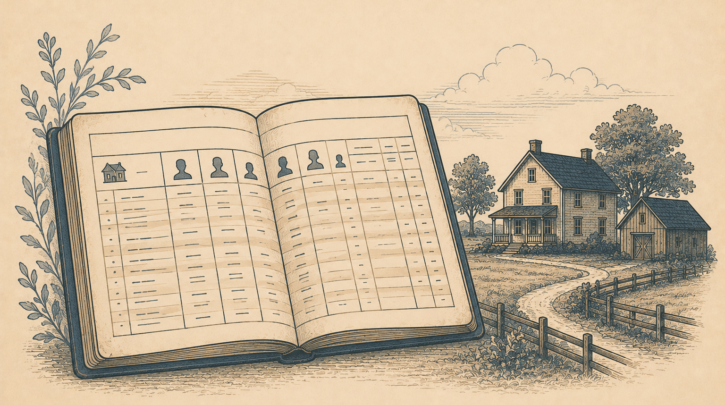
A Norwegian census entry is rich in detail. It places a household on a named farm (gård) within a parish, and lists each person with their name, position in the household (head, wife, child, servant, lodger), age or birth year, marital status and occupation. The later censuses add birthplace, which is enormously valuable for tracing a family back to where they came from. Reading a census household, you see the whole family together in one place at one time—the ideal foundation for finding their records in the church books.
The 1801 census: a special treasure
The 1801 census deserves particular mention. Unusually early for a full, named census, it recorded every inhabitant of Norway by name, household and farm, giving a comprehensive snapshot of the population at the turn of the nineteenth century. For a researcher who has traced a family back to the early 1800s, the 1801 census is a wonderful anchor, placing ancestors on their farm and within their household at a moment when few other countries have comparable records. It is fully searchable free on the Digital Archives.
The Norwegian censuses are searchable free on the Digital Archives. Start there via the records hub, then move into the church books.
How to use them
The method is to use the censuses as stepping stones and anchors. Find your family in the most recent census where you expect them, note the farm and the whole household, then work backward through earlier censuses, watching the household change as children are born and grow and—crucially—as the family perhaps moves farm. Each census placement then directs your search in the church books for that farm and parish. The birthplaces in the later censuses are especially powerful for tracing a family back to an earlier home.
Cautions
Censuses are excellent but not infallible. Ages were often approximate and can differ between censuses; names appear in varying spellings; and a person present elsewhere on census night—a servant on another farm, a fisherman at sea—may not appear where you expect. As always in Norwegian research, confirm identities by the whole cluster of detail—names, ages, farm, household relationships—rather than a single fact, and remember that the farm name attached to a person reflects where they lived at that moment, not a fixed surname. Used with that care, the censuses are the strong, accessible framework on which Norwegian research is built.
Using censuses and church books together
The real power of the censuses emerges when you combine them with the church books. A census places your family on a named farm in a given year, with ages that point to birth years and a household that shows the family group; you then take that farm and those approximate dates into the parish church books to find the actual baptisms, marriages and burials. Working back and forth—census to locate and frame the family, church book to document each event—is the fundamental rhythm of Norwegian research. Each census placement narrows the church-book search to a specific farm and span of years, turning what could be an endless browse into a targeted lookup, while the church books in turn confirm and extend what the census sketches.