
If Norwegian genealogy has a secret weapon, it is the bygdebok—the local history book, and especially the farm-and-family history, that documents the families of a rural district across the generations. Found in few other countries, the bygdebok can hand you generations of your family already researched, farm by farm, sometimes back to the 1600s. For anyone with rural Norwegian roots, learning what a bygdebok is and how to use it is among the most rewarding steps in the whole search. This guide explains it.
What a bygdebok is
A bygdebok (literally “district book”) is a local history compiled for a Norwegian rural district (bygd), usually by a local historian and often published across several volumes. They come broadly in two kinds: a general local history (bygdehistorie), covering the district’s past, and—of prime interest to genealogists—a farm and family history (gårds- og slektshistorie), which documents each farm in the district and the families who lived on it. It is this farm-and-family type that makes the bygdebok a genealogical treasure.
Not sure where to start with your Norwegian ancestry?
Get the Norwegian Genealogy Quick-Start Checklist — a 5-step path to your first real ancestor record, plus the naming quirk that trips up almost everyone at first.
Why they are so valuable
The farm-and-family bygdebok is organised by farm, and for each farm it typically traces the succession of families and individuals who lived there—often generation by generation, with names, dates and relationships, sometimes reaching back to the 1600s or earlier. Because Norwegian identity and records are so bound to the farm, this farm-by-farm structure captures families across time in a way that is extraordinarily useful. If a bygdebok covers your ancestral farm, it may already contain much of your family tree—researched, organised, and waiting for you.
A starting point and a check
The bygdebok serves the researcher in two ways. As a starting point, it can leap you back several generations quickly, giving you a framework of names and dates to then confirm in the primary records. As a check, it lets you compare your own findings against a local historian’s work, catching errors and suggesting connections. Either way, it is best used alongside the primary records, not instead of them—a powerful guide to be verified, as we discuss below.
Finding the bygdebok for your district
To use a bygdebok, you must first know your family’s farm and district, then find whether a bygdebok covers it—most Norwegian rural districts have one, though coverage and quality vary. Many have been digitised by the National Library of Norway and can be read online (some access may be limited by region), while others are held in Norwegian libraries and archives, and copies sometimes reach major genealogical libraries abroad. Norwegian-American genealogical societies and libraries, serving the large diaspora, often hold or can help locate bygdebøker for the districts their communities came from.
A bygdebok can leap your research back generations—but confirm it in the free Digital Archives. Find your farm first with finding your farm and parish.
Using a bygdebok well
When you find your farm in a bygdebok, read its entry carefully, noting the families and individuals recorded and how they connect to your line. Then verify the key links in the primary records—the church books, censuses and probate records—because a bygdebok, however good, is a secondary source that can contain errors or gaps. Used this way, it accelerates your research enormously while your own verification keeps it accurate: the best of both worlds.
A resource to treasure
For the family historian with rural Norwegian roots, the bygdebok is a resource to treasure—a body of dedicated local scholarship that, for many districts, has already done much of the hard work of tracing families across the centuries. Not every district is covered, and every bygdebok should be verified, but where one exists for your ancestral farm, it can transform your research, connecting you to generations of ancestors and to the deep history of the very place they lived. Seek out the bygdebok for your district early—it may hold more of your family than you dared hope.
What you’ll find in a farm entry
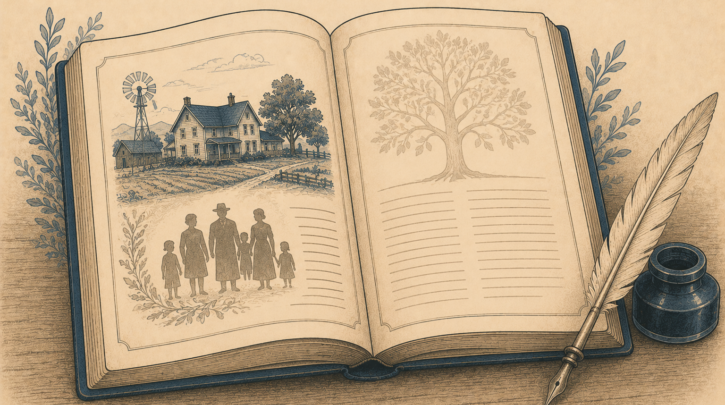
It is worth knowing what a good farm-and-family bygdebok entry actually looks like, so you can use it fully. For a given farm, the entry typically sketches the farm’s history—its name, location and development—and then works through the succession of families who held or lived on it, generation by generation: the household head, spouse, marriage, children, and often where those children went (including, tellingly, who emigrated to America). Dates of birth, marriage and death are usually given, and cross-references may point to other farms where family members moved. Read carefully, such an entry does not just list names but shows the family in the context of the farm and the community across time—which is precisely why, when a bygdebok covers your ancestral farm, it can illuminate your family history in a way scattered records alone rarely match.