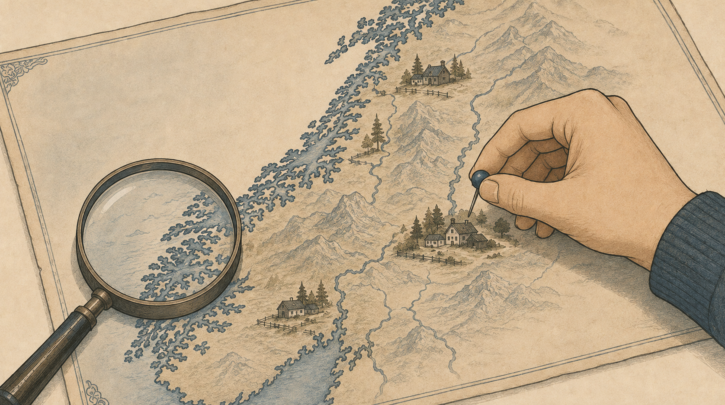

Norwegian records—and the bygdebøker—are organised by farm and parish, so to find your family you generally need to know where in Norway they came from. “Somewhere in Norway” is rarely enough. The good news is that the clue is usually recoverable—and Norwegian ancestry offers a special advantage: the emigrant often carried the farm name as a surname, which frequently names the very place. This guide shows you where to look.
Why the farm and parish matter
There is no single search that returns a Norwegian ancestor by name across the whole country with certainty; the records are arranged by parish and by farm, much of the church-book material is browsed by parish, and the bygdebøker are organised farm by farm. Identifying the farm and parish is therefore the prerequisite for efficient research—the key that turns a hopeless nationwide hunt into a precise search of one place’s records. It matters all the more given how patronymics and farm names work, which makes name-only searching unreliable.
Not sure where to start with your Norwegian ancestry?
Get the Norwegian Genealogy Quick-Start Checklist — a 5-step path to your first real ancestor record, plus the naming quirk that trips up almost everyone at first.
The farm name in the emigrant’s name
Here is Norway’s special advantage. Because Norwegians were known by the farm they lived on, an emigrant frequently carried that farm name as a surname—and it often stuck in America as the family’s fixed surname. So a Norwegian-American surname like Berg, Haugen, Moen, Sletten or Fjelstad may well be the name of the very farm the family left in Norway. This is a powerful clue: the surname itself may point you toward the ancestral farm, something to explore alongside our guide to Norwegian surname changes in America.
The best sources
Look to the records your ancestor generated after leaving Norway, which so often name the origin:
- The emigrant’s farm-name surname — which may itself be the ancestral farm.
- Emigration records — the Norwegian emigration lists, which often name the home parish.
- Records created abroad — naturalisation papers, censuses, church and death records naming a Norwegian birthplace.
- Family knowledge — the farm, parish or district name remembered in the family.
Understand the geography
It helps to understand Norway’s administrative hierarchy, which organises the records. The farm (gård) sits within a parish (sogn), often grouped into a clerical district (prestegjeld); parishes sit within a municipality (kommune) and a county (fylke). Church books were kept by the clerical district and parish, so pinning down the parish is what lets you find the church records, while the farm pins down the bygdebok entry and the census household. Knowing this structure helps you turn a vague place name into a precise location to search.
Found the farm and parish? The records open up—most of them free. Head to the Digital Archives guide and the records hub to start searching.
Mind the same-named farms
A caution: many Norwegian farm names recur across the country—there are countless farms named Berg, Haugen, Dahl, Moen or Lien—so a farm name alone rarely pins down a location. You must pair the farm name with its parish, municipality and county to be sure you have the right place, and be wary of assuming that a common farm-name surname points to one specific spot. Gazetteers of Norwegian farm names and the census records help you locate and confirm a candidate farm precisely.
Confirming your farm and parish
When you have a candidate farm and parish, confirm it before deep research: look for your family there in the censuses and church books, checking that the names, ages and relationships match what you know from abroad. Finding them, with the details aligning, confirms you have the right place and not a same-named farm elsewhere. This quick check marks the real beginning of your Norwegian research—and, often, the moment a family surname is revealed to be the name of a farm you can now go and find, in the records and perhaps one day in person.
When the trail is vague
If the paper trail only gets you to a region or a county, a few further techniques help. Chain migration meant Norwegians from one district often settled together in America, so identifying where your ancestor’s neighbours, fellow church members or the wider local Norwegian settlement came from can reveal the shared home district. DNA matches who know their farm and parish can point the way—see DNA testing. And the strong Norwegian-American community records—Lutheran church records, bygdelag (regional heritage associations organised by Norwegian home district), and local histories—often preserve clear knowledge of families’ origins. Finding the farm and parish takes patience, but it is the highest-value work in Norwegian genealogy, because nearly everything else—the church books, the censuses, the bygdebok—depends on it, and the distinctive farm-name surnames give you a head start few other ancestries offer.