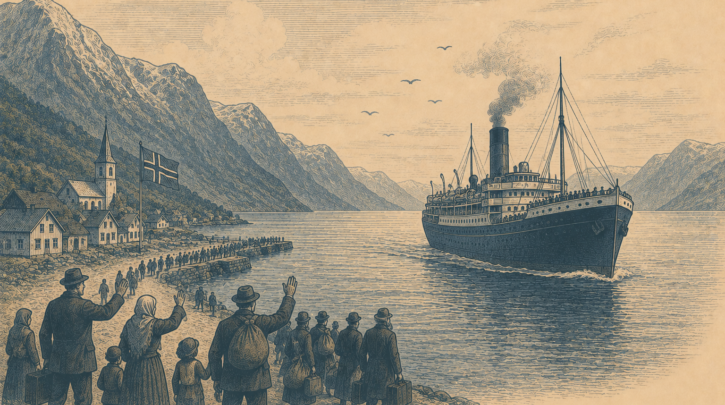

Few nations sent so large a share of their people across the sea as Norway. Between 1825 and 1925, roughly 800,000 Norwegians emigrated—the equivalent of about a third of the country’s population—giving Norway one of the highest emigration rates in all of Europe, second only to Ireland. Almost all of them went to the United States, and especially to the Upper Midwest, where they built one of America’s most enduring immigrant cultures. If your family came from Norway, they were almost certainly part of this great migration. This guide tells the story and shows how to trace an ancestor through it.
The scale of the exodus
The numbers are staggering for so small a country. Over the century of mass emigration, Norway lost to America a share of its population matched by hardly any other European nation, emptying valleys and rural districts and reshaping both Norway and the American Midwest. For the family historian, this scale means two things at once: your emigrant ancestor was one of a vast, well-documented movement, part of a flood of neighbours and kin who often left together; and the migration generated abundant records—on both sides of the Atlantic—that make tracing an individual emigrant genuinely achievable. The very ordinariness of emigration in nineteenth-century Norway is what makes it so traceable today.
Not sure where to start with your Norwegian ancestry?
Get the Norwegian Genealogy Quick-Start Checklist — a 5-step path to your first real ancestor record, plus the naming quirk that trips up almost everyone at first.
It began with the Sloopers
The great migration has a precise and celebrated beginning: in 1825, a small sloop called the Restauration sailed from Stavanger to New York carrying about 52 emigrants—the first organised group emigration from Norway, and an event so foundational it is often called the “Norwegian Mayflower.” These first emigrants, the Sloopers, were largely religious dissenters seeking freedom from the Lutheran state church, and their journey—and the settlements they founded—opened the path that hundreds of thousands would follow. From this small beginning grew the flood.
Why they left
The reasons were a mix of hardship at home and promise abroad. A booming population pressed against Norway’s limited farmland, leaving many—especially the landless cottars (husmenn) and younger children with no land to inherit—with bleak prospects. Against this, America offered abundant, cheap or free land, wages, and opportunity, and the famous “America letters” home spread an “America fever” (Amerikafeber) through the districts. We explore these drivers in why Norwegians emigrated. Early on, religious dissent played a real part too; later, sheer economic opportunity and the pull of family already settled carried the movement forward.
The waves of migration
Emigration built in waves. After the 1825 Sloopers came a trickle in the 1830s and 1840s, when the first Midwest settlements were founded; then, from the 1860s, emigration became a mass movement, swelling to its greatest heights in the 1880s—the single largest decade—and surging again around 1900 to 1910. It wound down in the 1920s, as American immigration quotas closed the door and Norway’s own economy improved. Knowing which wave your family belonged to helps orient your research, pointing to the likely records, routes and destination communities of that era.
The Upper Midwest
Norwegian emigrants concentrated overwhelmingly in the Upper Midwest. Wisconsin received the first major settlements in the 1840s; Minnesota became the heartland, drawing more Norwegians than any other state; and Iowa, and later the Dakotas, filled with Norwegian farmers taking up homestead land. The distinctive feature of this settlement was clustering by home district—emigrants from a particular Norwegian valley or region tended to settle together—which shaped Norwegian America and is a valuable clue for the researcher, as we explore in Norwegian settlement in the Midwest.
Chain migration and the bygdelag
Once Norwegians had established themselves, chain migration took over: relatives and neighbours followed those who had gone before, drawn by the America letters and the promise of help on arrival. This is why Norwegian America clustered so tightly by origin, and it gave rise to a distinctive institution—the bygdelag, associations of immigrants and their descendants from the same Norwegian home district. These lag, along with Lutheran churches and later Sons of Norway, preserved regional identity and, valuably for the genealogist, ties to specific home districts, as we discuss in the diaspora and assimilation.
Tracing an emigrant ancestor
For the genealogist, the great migration is not just history but a documented trail. Norwegian police emigration records, the church books’ out-migration lists, the records your ancestor generated in America, and—distinctively—the farm name many emigrants carried as a surname can together carry you from an immigrant in Minnesota or the Dakotas back to a specific farm and parish in Norway, and from there into the deep church books and bygdebøker. The whole method is laid out in finding your Norwegian emigrant ancestor.
A story worth recovering
The great Norwegian emigration is one of the defining facts of the modern Norwegian people, kept alive across the American Midwest in Lutheran churches, in the bygdelag, in Sons of Norway lodges, in the syttende mai celebrations of Norwegian Constitution Day, and in a fierce pride in Norwegian roots. Behind the vast numbers were individual families making a hard choice to leave everything for an uncertain future across the sea. Recovering your family’s particular story—from the farm they left to the prairie they broke—is what this cluster of guides is here to help you do, and it can even lead you home to reclaiming the heritage they carried.