
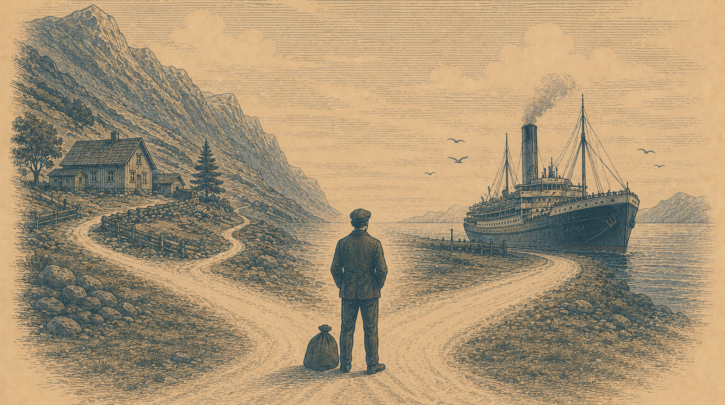

Why did so many Norwegians—something like a third of the whole nation—leave their homeland over the century after 1825? The decision to emigrate was rarely made lightly, and understanding what drove your ancestors to go deepens your sense of their story and explains the pattern of the migration. The causes were a mix of hardship at home and promise abroad, and they shifted over the decades. This guide explains them.
A growing population and limited land
At the root of Norwegian emigration lay a simple, hard arithmetic: a rapidly growing population pressed against a country with very limited farmland. Through the nineteenth century Norway’s population grew dramatically, but the amount of arable land—in a mountainous nation of narrow valleys and steep fjordsides—could not grow with it. Farms could only be subdivided so far before they could no longer support a family, and inheritance customs meant many children would never inherit land at all. The result was a mounting pressure of people with no realistic prospect of a farm of their own, for whom emigration offered an escape the homeland could not.
Not sure where to start with your Norwegian ancestry?
Get the Norwegian Genealogy Quick-Start Checklist — a 5-step path to your first real ancestor record, plus the naming quirk that trips up almost everyone at first.
The landless cottars
This pressure fell hardest on the husmenn, the cottars or landless labourers who worked others’ land in exchange for their tenancy and had little hope of ever owning a farm. As their numbers swelled through the century, so did the ranks of those with the strongest reasons to leave. For a husmann family, or for the younger sons and daughters of farmers who would inherit nothing, America’s offer of land was transformative—the chance to become independent landowners, unimaginable at home. Much of the great emigration was, at bottom, a hunger for land that Norway could not satisfy and America seemingly could.
The pull of American land
Against the push of Norwegian land hunger came a powerful pull: cheap and free land in America. The frontier of the Upper Midwest offered fertile farmland at low prices, and the Homestead Act of 1862 promised free land to those who would settle and work it. For Norwegians shut out of landownership at home, this was an almost irresistible prospect, and it drew them in their hundreds of thousands to the farming country of Minnesota, the Dakotas and beyond. The dream of a farm of one’s own—denied in Norway, offered in America—was perhaps the single greatest motive of the whole migration.
America fever and the America letters
Emigration fed on itself through the famous “America letters” (Amerikabrev). Those who had gone before wrote home describing the opportunities—the land, the wages, the freedom—and these letters, read aloud and passed around whole districts, spread a powerful “America fever” (Amerikafeber). The letters made America concrete and attainable, told people exactly where to go and whom to find, and turned emigration from a fearful leap into a well-trodden path. This flow of information, from emigrant to home village, was one of the great engines of the migration, and it is why emigration clustered so tightly by district.
Religious dissent
In the earliest years, religious dissent played a notable part. The very first emigrants, the Sloopers of 1825, were largely Quakers and Haugean pietists seeking freedom from the constraints of the Lutheran state church, which dominated Norwegian religious life. While religious motives faded relative to economic ones as the migration grew into a mass movement, the desire for religious freedom gave the emigration its founding impulse and shaped its first settlements—a reminder that the earliest Norwegian emigrants left as much for conscience as for land.
Chain migration
Once Norwegians had established themselves in America, chain migration became a driver in its own right. Relatives and neighbours followed those who had gone before, drawn by the America letters, the offer of a place to stay and help finding work or land, and the reassurance of a familiar community. This is why Norwegian settlement clustered so tightly by home district—whole valleys effectively transplanted to particular corners of the Midwest—and it is a valuable clue for the researcher, since an emigrant’s American neighbours often came from their very home district in Norway, a point we return to in finding your emigrant ancestor.
A changing mix over time
The balance of motives shifted across the century. The earliest emigration was coloured by religious dissent and adventure; the great mass movement from the 1860s was driven above all by land hunger and the pull of American opportunity; and the later waves around 1900 increasingly reflected ordinary economic aspiration and the momentum of established chains, as emigration became simply a normal path for young Norwegians. Understanding which era your family left in—and which motives dominated then—adds depth to their story and context to the records they left. Whatever the particular mix, the great emigration was, at heart, a search for the security and opportunity that a crowded, land-poor Norway could not offer.