
Every great migration has a beginning, and Norway’s has a precise and celebrated one: in 1825, a small sloop named the Restauration sailed from Stavanger to New York carrying about 52 emigrants—the first organised group emigration from Norway to America. These pioneers, the Sloopers, and their little ship, so often called the “Norwegian Mayflower,” opened the path that hundreds of thousands would follow. Their story is the founding chapter of the whole Norwegian-American experience. This guide tells it.
The voyage of the Restauration
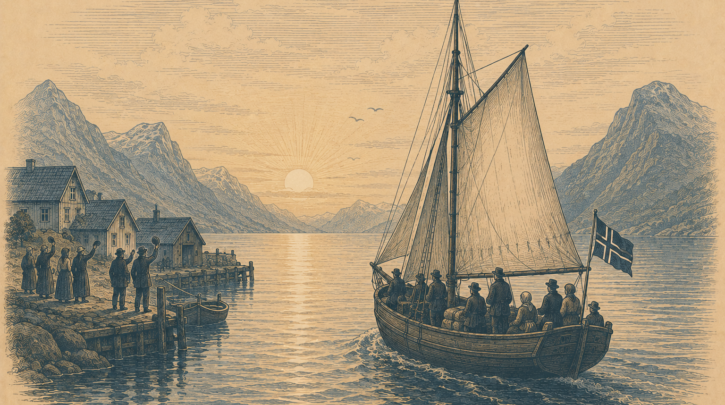
In July 1825, the sloop Restauration—a small vessel for an ocean crossing, carrying around 52 people—set sail from Stavanger on Norway’s southwest coast, bound for New York. After a long and eventful voyage of some three months, the little ship reached New York in October 1825. The crossing became legendary for its daring and its hardships, and the safe arrival of this first organised party of Norwegian emigrants marked the true beginning of Norwegian emigration to America—an event whose centennial and bicentennial have been celebrated as milestones of Norwegian-American history.
Not sure where to start with your Norwegian ancestry?
Get the Norwegian Genealogy Quick-Start Checklist — a 5-step path to your first real ancestor record, plus the naming quirk that trips up almost everyone at first.
The ‘Norwegian Mayflower’
The Restauration is often called the “Norwegian Mayflower,” and the comparison is apt. Just as the Mayflower carried the first defining group of English settlers, the Restauration carried the first organised group of Norwegian emigrants, and its passengers hold a place in Norwegian-American memory much like the Pilgrims in American memory. The name captures both the pioneering nature of the voyage and its symbolic weight: this was the small beginning from which a vast migration grew, the first thread of a story that would eventually involve a third of the Norwegian nation.
Who the Sloopers were
The Sloopers were, in large part, religious dissenters. Many were Quakers, and others were influenced by the Haugean pietist movement—both at odds with the dominant Lutheran state church, which held a powerful grip on Norwegian religious life and restricted dissenting worship. For these emigrants, America promised religious freedom as much as economic opportunity: the liberty to worship as they chose, free from the constraints and disabilities they faced at home. This religious impulse gave the founding wave of Norwegian emigration a particular character, one of conscience and conviction, that distinguished it from the land-driven mass migration to come.
Cleng Peerson, the pathfinder
No figure looms larger in the Slooper story than Cleng Peerson, often called the “father of Norwegian emigration.” A restless pathfinder, Peerson travelled to America ahead of the group to scout the way, helped organise the venture, and guided the settlement of the emigrants once they arrived—and he continued for decades to lead Norwegians to new lands in the American interior. His role as scout, organiser and guide made the Slooper migration possible and shaped the direction of Norwegian settlement that followed. Peerson embodies the pioneering spirit of the founding emigration, and his name is honoured throughout Norwegian America.
From Kendall to the Fox River
The Sloopers first settled in Kendall, in western New York State, where they struggled with unfamiliar and difficult conditions. Within a decade, seeking better land, many moved west to the Fox River settlement in Illinois, established in the 1830s—a move that proved decisive. The Fox River settlement became a “mother colony” of Norwegian America: a foothold from which Norwegians spread further into the Midwest, and a destination that drew later emigrants. The Sloopers’ journey from Kendall to the Fox River traced the first steps of the westward path that would carry Norwegian settlement to Wisconsin, Minnesota and beyond.
Why the Sloopers matter for research
For most researchers, the Sloopers will not be direct ancestors—they were a tiny group—but their story matters for understanding the migration that followed. They established the path and the pattern: the routes, the early settlements, and the chain of information and encouragement that drew later emigrants. If your family did descend from a Slooper or an early Fox River settler, you are connected to the very origin of Norwegian America, and the well-documented history of these pioneers offers rich resources. For everyone else, the Sloopers are the founding context—the small beginning that made the great migration, and your own family’s part in it, possible.
A founding legacy
The legacy of the Sloopers far outweighs their small numbers. From 52 emigrants on a single sloop grew a migration of hundreds of thousands and a Norwegian-American culture that endures to this day across the Midwest. Their voyage is commemorated as the beginning of that story, a symbol of the courage and conviction that launched the whole movement. When you trace your own Norwegian emigrant ancestors—whenever they left and wherever they settled—you are following a path that the Sloopers first opened in 1825, and their founding voyage is part of the heritage of every Norwegian-American family. Their story is, in a sense, the first page of your own.