
The central challenge of Norwegian diaspora genealogy is the leap across the ocean: connecting your immigrant ancestor in America to the specific farm and parish in Norway where their records live. Get that place, and Norway’s rich, largely free records open up; miss it, and the trail goes cold at the water’s edge. The good news is that the migration was well documented on both sides—and Norwegian ancestry offers a special clue few others do. This guide gives you a practical method.
Norway’s special clue: the farm-name surname
Begin with an advantage unique to Norwegian research. Because Norwegians were known by the farm they lived on, an emigrant often carried that farm name—and it frequently stuck in America as the family’s fixed surname. So a Norwegian-American surname like Berg, Haugen, Moen, Sletten, Fjelstad or Rud may well be the name of the very farm the family left in Norway. This is a powerful head start: your American surname itself may point toward the ancestral farm. It is not certain—many farm names recur, and some families froze a patronymic instead—but it is always worth investigating first, as explored in Norwegian surname changes in America.
Not sure where to start with your Norwegian ancestry?
Get the Norwegian Genealogy Quick-Start Checklist — a 5-step path to your first real ancestor record, plus the naming quirk that trips up almost everyone at first.
Start with what America recorded
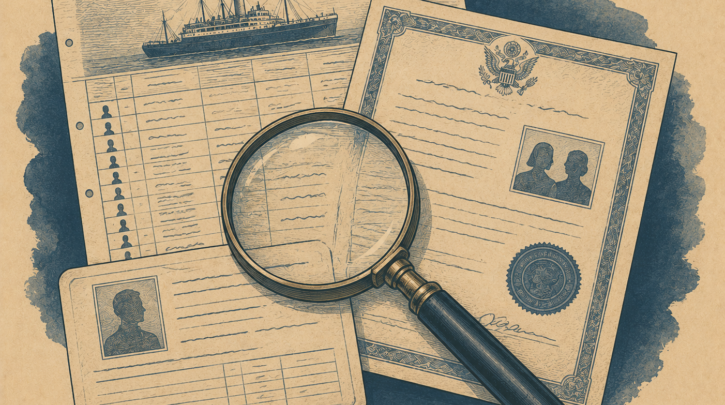
Gather everything the American records say about your ancestor, because the clue to the Norwegian origin often hides there. Work through:
- Census records, which give Norway as birthplace and, in some years, more detail.
- Naturalisation papers, which may name a specific origin or arrival details.
- Church records—especially the Norwegian Lutheran congregations—which often recorded members’ Norwegian origins.
- County and local histories and obituaries, which frequently name the emigrant’s home district or parish.
Use the police emigration records
A powerful Norwegian resource is the police emigration record (utvandringsprotokoll). From the late 1860s, Norwegian police at the emigration ports—Kristiania (Oslo), Bergen, Trondheim, Stavanger and others—kept registers of emigrants, typically naming the emigrant, their home parish or district, age, and destination. Because they were created in Norway at the point of departure, these lists can link an emigrant directly to their home place, making them one of the best bridges across the ocean. Many are digitised and searchable on the Digital Archives, and they are well worth seeking for any emigrant ancestor.
Check the church out-migration lists
Norwegian church books often recorded people moving out of the parish (utflyttede), including those emigrating to America. If you can identify the likely home parish—perhaps from a farm-name surname or a family tradition—the church book’s out-migration list may record your ancestor’s departure, confirming the origin and often the destination. These lists complement the police records and can be especially useful for earlier emigrants or for confirming a candidate parish, tying the emigrant firmly to a specific Norwegian congregation.
Confirm in the Norwegian records
Once a source gives you a candidate farm or parish, confirm it in the Norwegian records. Look for your emigrant’s baptism and family there—in the church books and the censuses—with the parents’ names, ages and farm matching what you know from America. Finding them, with the details aligning (and perhaps a bygdebok entry confirming the family), establishes that you have the right place and person, not a coincidental match—essential given how patronymics and farm names can mislead.
Handle the naming and spelling
Two naming difficulties recur and should be planned for. First, Norwegian names in the records worked by patronymic and farm, not fixed surname, so match your emigrant by given name, patronymic (the father’s name), farm, parish and dates rather than a surname alone. Second, names were often changed in America—spellings anglicised, the letters ø and å simplified, patronymics or farm names frozen—so you may need to reverse the change to recognise the Norwegian original. Neither is insurmountable; both simply call for flexibility and for reconstructing the whole family group rather than trusting a single spelling.
Use the community’s clustering
Finally, exploit the tight clustering of Norwegian America. Because emigrants from one district settled together, the origins of your ancestor’s American neighbours, fellow church members and the wider local Norwegian community are a strong clue to their own. If the families around your ancestor came from a particular Norwegian valley, yours very likely did too. The bygdelag—associations organised by Norwegian home district—and local Norwegian-American histories can reveal these shared origins, and DNA matches who know their farm can point the way. Combined with the records, this clustering makes the path from a Midwest farm back to a Norwegian one genuinely recoverable—often all the way into the deep church books and bygdebøker.