
While the United States overwhelmingly dominated Norwegian emigration, Canada also played a part in the story—first as a gateway on the way to the American Midwest, and later as a settlement destination in its own right, especially on the Prairies. If your Norwegian family settled in Canada, or passed through it, this guide traces that story and shows how to research a Norwegian-Canadian connection.
Quebec as an early gateway
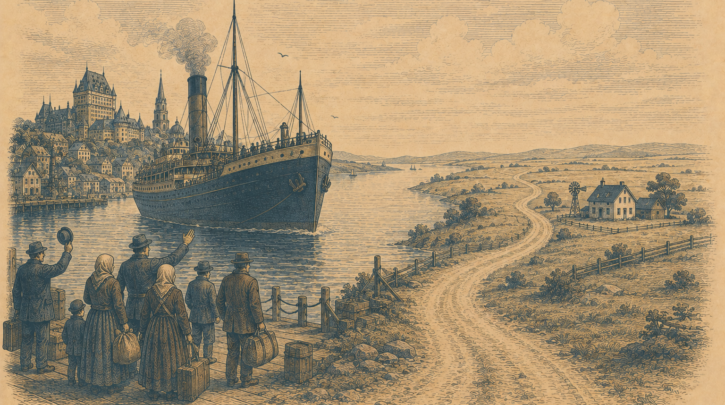
In the earlier decades of the migration, Quebec was a common port of entry for Norwegian emigrants—not as a destination but as a transit point. Many early emigrants sailed on timber ships that carried Norwegian and Baltic timber to Canada and returned with emigrant passengers, landing at Quebec. From there, the emigrants travelled onward—overland and by the Great Lakes—to the United States and the Norwegian settlements of the Upper Midwest. So a family that “entered through Canada” in the early years very often did not settle there at all, but passed through Quebec on their way to Wisconsin or Minnesota, a routing worth bearing in mind when you find a Canadian port of arrival.
Not sure where to start with your Norwegian ancestry?
Get the Norwegian Genealogy Quick-Start Checklist — a 5-step path to your first real ancestor record, plus the naming quirk that trips up almost everyone at first.
Later settlement in Canada
From the later nineteenth century and into the early twentieth, Canada became a genuine settlement destination for Norwegians, as opposed to merely a transit point. As the Canadian government promoted settlement of the western provinces, Norwegians—some coming directly from Norway, many moving north from the crowded American Midwest—took up land on the Canadian Prairies. This later Norwegian-Canadian settlement, though far smaller than the migration to the United States, established real Norwegian communities in Canada, particularly in the western provinces.
The Prairie provinces
Norwegian settlement in Canada centred on the Prairie provinces—Saskatchewan and Alberta especially, and Manitoba—where the opening of western farmland in the early twentieth century drew settlers much as the American frontier had a generation earlier. Many of these Norwegian-Canadian settlers came not directly from Norway but from Norwegian communities in the American Midwest, moving north for new land as the American frontier filled. This means Norwegian-Canadian family histories often have an American chapter, and tracing them may lead back through the United States before reaching Norway.
Movement between the US and Canada
The border between Norwegian America and Norwegian Canada was porous, and movement in both directions was common. Families moved from the American Midwest to the Canadian Prairies for land, and sometimes back again, and the Norwegian communities on both sides of the border were connected by kinship, church and shared origins. For the researcher, this means a Norwegian-Canadian family may have records on both sides of the border, and that the same research strategies—and the same clustering by Norwegian home district—apply across Norwegian North America as a whole.
Researching a Norwegian-Canadian family
Tracing a family that settled in Canada follows the familiar path, with attention to the possible American chapter. Work back through Canadian records—censuses, immigration and land records, church records—and, where the family came via the United States, through American records too, to identify the immigrant and their Norwegian origin. Watch for the farm-name surname and look for the home parish named in the records. Then cross to the Norwegian records to trace the family home.
A smaller but real community
Norwegian Canada, though far smaller than Norwegian America, is a real and enduring community with its own history, churches and traditions, particularly across the western provinces. For descendants, it offers the same rewards—a family history to recover and a heritage to reclaim—and the same strong records to do it with. Whether your family settled on the Canadian Prairies directly from Norway or arrived by way of the American Midwest, the path back to the Norwegian farm and parish is recoverable, and it leads, as all Norwegian research does, into the rich and largely free records of the homeland.
Why Canada drew fewer Norwegians
It is worth understanding why Canada received so many fewer Norwegians than the United States, because it shapes where the records and communities are. By the time Canada was actively promoting Prairie settlement in the early twentieth century, the great Norwegian emigration was already mature: vast, established Norwegian communities existed in the American Midwest, the America letters and chain migration pointed overwhelmingly toward the United States, and the best American farmland had drawn the earlier, larger waves. Canada’s Norwegian settlement therefore came later and smaller, often as a secondary movement of Norwegian-Americans seeking fresh land rather than a primary flow from Norway itself. This timing means Norwegian-Canadian communities, while real and enduring, are more scattered than the dense Norwegian belt of Minnesota and the Dakotas, and that a Norwegian-Canadian family’s story frequently runs back through the United States before it reaches Norway—a chapter to expect and to trace.
For the researcher, this has a practical upside: the same rich resources that serve Norwegian-American research—the bygdelag, the Lutheran church records, the clustering by home district, and above all the free Norwegian records—serve Norwegian-Canadian research just as well, since the two communities were so closely connected. Whether your family’s Canadian chapter was a brief transit through Quebec or a lasting home on the Prairies, the path back to the ancestral farm and parish runs through the same records and the same methods, and is every bit as recoverable.