
If you have followed this cluster to here, you may have reached a disappointing conclusion: like most descendants of Norwegian emigrants, you probably cannot claim Norwegian citizenship. We want to end not on that disappointment, but on a genuinely liberating truth: your Norwegian heritage does not depend on a passport. Everything that makes that heritage real and rewarding is open to you, citizenship or not. This guide is about embracing it fully.
Important: This article is general information for educational purposes, not legal advice. Nationality law is complex, fact-specific, and subject to change. Always verify your situation with the Norwegian authorities—the UDI (Norwegian Directorate of Immigration)—or a qualified immigration professional before acting.
Heritage was never about the passport
It is worth saying plainly, because the citizenship websites can leave the opposite impression. A Norwegian passport is a legal status, governed by rules of nationality law that happen, for most descendants, to exclude them—chiefly because the emigrant generation lost their citizenship on naturalising abroad. Your heritage, though—your descent from real Norwegian people, your connection to a particular farm and valley and family—is a matter of history and identity, and no rule of nationality law can grant or deny it. You are as much the descendant of your Norwegian forebears whether or not the UDI would issue you a passport. Once you see that the two things are separate, the citizenship disappointment loses most of its sting.
Not sure where to start with your Norwegian ancestry?
Get the Norwegian Genealogy Quick-Start Checklist — a 5-step path to your first real ancestor record, plus the naming quirk that trips up almost everyone at first.
Your documented family history
What remains open to you is not a consolation prize but the real substance of Norwegian heritage—beginning with your documented family history. Norway’s superb, largely free records—the church books, the censuses, the probate records, and the remarkable bygdebøker—let you trace your family back, often into the 1700s and beyond, with no eligibility test and no fee to any authority. To know the names, lives and places of your Norwegian ancestors, generation by generation, is a profound connection to them, and it asks nothing of you but curiosity and patience.
The ancestral farm
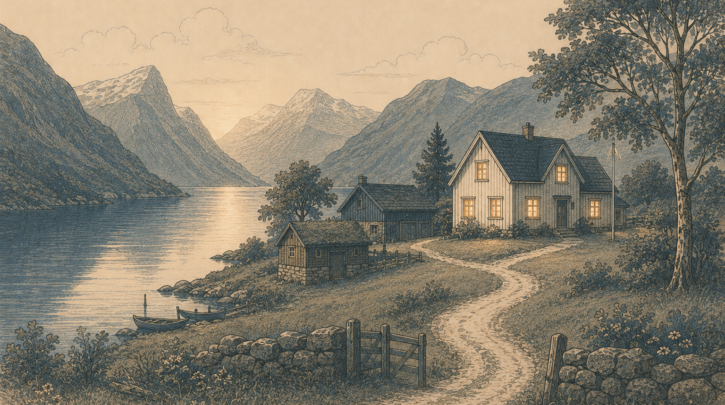
Norwegian heritage offers something special here: the farm. Because Norwegians were named for the farms they lived on, and because those farm names so often persist, you can frequently identify—and one day visit—the very farm your family came from, perhaps still bearing the name your surname carries. To stand on the ground your ancestors worked, in the valley they knew, is a connection to heritage that no passport could deepen, and it is open to any visitor. We explore making that journey in visiting your ancestral farm.
Living cousins
Your heritage includes living people. Because Norwegians and Norwegian-Americans test their DNA in large numbers, and because Norway’s records make relationships so traceable, you can find and connect with living cousins—in Norway and across the diaspora—who share your ancestors. Reaching relatives in the ancestral district, corresponding, perhaps meeting them on a visit, turns family history from a study of the dead into a relationship with the living. This, too, needs no citizenship—only the research and the reaching out.
The traditions
And there are the traditions—the living culture your emigrant ancestors carried and that you can reclaim: the bunad and the celebration of syttende mai (Norwegian Constitution Day), the foods of Norwegian-American life, the bygdelag and Sons of Norway that keep regional identity alive, the folk music, the language itself. To take up these traditions—to keep syttende mai, to learn some Norwegian, to join a Norwegian-American community—is to live your heritage, not merely study it. We gather these threads in how to reclaim your Norwegian heritage.
A note on the passport’s real value
None of this is to dismiss the passport’s value where a claim genuinely exists. A Norwegian passport carries European (EEA) free movement and is highly prized, and if you have a live claim through a parent or as a former citizen, it is well worth pursuing. But for the majority without such a claim, chasing a citizenship the law does not offer only brings frustration, while the heritage—richer and more personal than any document—waits to be reclaimed. It is a question of putting your energy where it will actually reward you.
From passport to homecoming
For many descendants, letting go of the passport hope is the moment the real journey begins. Freed from chasing a citizenship the law does not provide, you can pour your energy into what genuinely connects you to Norway: the records that name your ancestors, the farm they came from, the cousins who share them, the traditions that carried across the ocean. That is a richer inheritance than a document, and it is entirely, unconditionally yours. Where the citizenship answer is usually no, the heritage answer, for everyone with Norwegian roots, is an unqualified yes—so begin with the records, and let them lead you home.