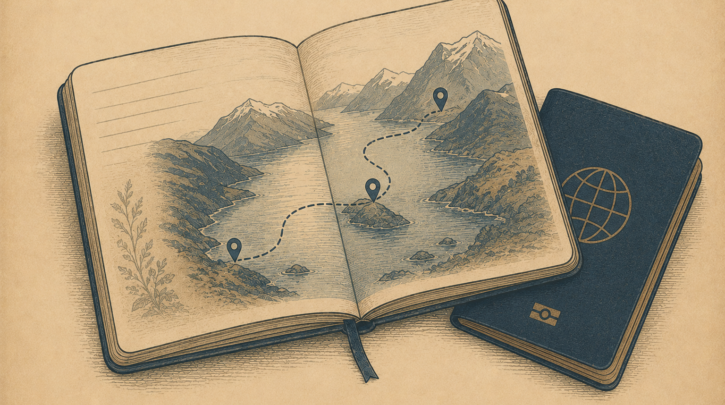

There may be no more moving way to connect with your Norwegian roots than to go to Norway—to stand on the farm your family left, walk the parish they knew, and see the fjords and valleys that shaped them. A Norwegian heritage trip can be the culmination of all your research, and Norway offers something special: because farm names persist and the farms so often still exist, you can frequently visit the very place your ancestors came from. This guide shows you how to plan a trip that turns names in the records into ground beneath your feet.
Do the genealogy first
The single most important step comes before you book anything: do the genealogy first. A Norwegian heritage trip is only as good as the research behind it, because to visit your ancestral farm and parish you must first know exactly where they are. Use Norway’s free records to trace your family, identify the specific farm and parish, and learn who lived there and when. The difference between arriving with a precise farm name and parish and arriving with only “somewhere in Norway” is the difference between a homecoming and a vague tour. Research first; travel second.
Not sure where to start with your Norwegian ancestry?
Get the Norwegian Genealogy Quick-Start Checklist — a 5-step path to your first real ancestor record, plus the naming quirk that trips up almost everyone at first.
What makes Norwegian heritage travel special
Norway offers the heritage traveller a rare gift: the chance to visit the actual farm. In many ancestries you can visit only a region or a town; in Norway, because your ancestors were named for their farm and those farms so often survive—still bearing the same name, sometimes still worked—you can frequently identify and visit the specific farmstead your family left. To stand on that ground, perhaps beside buildings your ancestors knew, is an experience of extraordinary intimacy, and it is what makes a Norwegian roots trip so uniquely powerful. We cover it fully in visiting your ancestral farm.
Visiting the farm and parish
At the heart of your trip are the farm and the parish church. The farm is where your family lived and worked; the parish church is where they were baptised, confirmed, married and buried, and its churchyard may hold their graves. Together they form the core of a heritage visit—the lived landscape and the spiritual centre of your ancestors’ world. Plan to spend real time in the parish: see the church, walk the churchyard, take in the farms and the terrain, and let the place your family called home for generations become real to you in a way no document ever quite can.
Exploring the region and fjords
Beyond the specific farm lies the region—the fjord, valley or coast that shaped your ancestors’ lives and character. Norway’s landscape is among the most beautiful on earth, and it is also your heritage: the steep fields your farming ancestors worked, the fjord your seafaring forebears fished, the mountains that isolated and defined a district. Seeing this landscape is part of understanding where you come from, as we explore in Norwegian heritage regions and fjords. Build time into your trip to experience the country your family came from, not just the single farmstead.
The best heritage trips start with solid research. Trace your family and pin down the farm using the free records and the research guide before you travel.
Connecting with living relatives
A heritage trip can become truly unforgettable when it includes living relatives. Because Norway’s records make relationships so traceable and many Norwegians have tested their DNA, you can often identify and contact cousins still living in the ancestral district—and meeting them, seeing the family resemblance, being shown the family’s places by someone who still lives among them, transforms a trip from sightseeing into reunion. Reach out ahead of time where you can; local relatives, and local history societies, can open doors—sometimes literally—that a visitor could never open alone.
Museums and the wider story
To enrich your understanding, weave in Norway’s excellent museums. Open-air folk museums such as Norsk Folkemuseum in Oslo and Maihaugen at Lillehammer preserve historic farm buildings, stave churches and the material world of rural Norway, showing how your ancestors lived. The Norwegian Emigrant Museum tells the story of the great emigration itself. These museums place your family’s particular story within the wider Norwegian experience, and they are especially valuable for seeing the vanished details of daily life—the buildings, tools and costume—that the farm alone may no longer show.
Practical planning
A few practicalities help. Norway is well-organised for travel but can be expensive, so plan ahead; consider the season (summer offers long days and access to the countryside; some rural sites are hard to reach in winter); and think about transport, since reaching a remote ancestral farm may need a car. If your visit coincides with 17 May (syttende mai, Constitution Day), you will see Norwegian identity at its most joyful. Allow enough time in the ancestral district itself—this is not a place to rush—and prepare the farm visit thoughtfully, as covered in our dedicated guides.
The homecoming
A Norwegian heritage trip is the point where research becomes emotion—where the names, dates and farms you have studied become a real place, real graves, real cousins, real landscape. For many descendants it is the most meaningful journey of their lives: a homecoming to a country their family left generations ago but never wholly left behind. And it needs no citizenship and no passport but your own—only the research to find the way and the will to go. Trace your family, find the farm, and let Norway welcome you home to the very ground your ancestors walked.