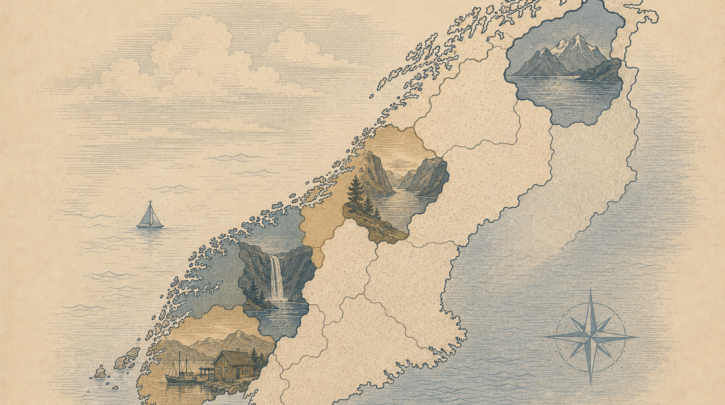

Your Norwegian ancestors were shaped by a particular corner of an extraordinary country—a fjord, a valley, a stretch of coast—and part of a heritage trip is coming to know that landscape. Norway’s regions differ greatly in character, and understanding which one your family came from, and what it is like, deepens your sense of your roots and shapes your journey. This guide surveys Norway’s heritage regions and its famous fjords, and how the land formed the people who became your ancestors.
A country shaped by landscape
More than almost anywhere, Norway is defined by its landscape—a long, narrow country of mountains, deep fjords, narrow valleys and a vast coastline, where farmland is scarce and hard-won. This geography shaped your ancestors profoundly: it dictated where and how they could farm, drove the fishing and seafaring of the coast, isolated communities in remote valleys, and—by limiting the land—helped drive the great emigration. To understand the Norwegian landscape is to understand much about why your ancestors lived as they did, and why so many ultimately left. The scenery is not just beautiful backdrop; it is the shaping force of your heritage.
Not sure where to start with your Norwegian ancestry?
Get the Norwegian Genealogy Quick-Start Checklist — a 5-step path to your first real ancestor record, plus the naming quirk that trips up almost everyone at first.
The western fjords (Vestlandet)
Norway’s western fjord country (Vestlandet) is the landscape most associated with Norway—deep fjords cutting between steep mountains, with farms clinging to narrow shelves of land beside the water. Districts here, in the counties around Bergen and the great fjords, sent many emigrants, driven by the scarcity of farmland on those precipitous slopes. If your family came from the western fjords, their world was one of dramatic beauty and genuine hardship: tiny farms, the fjord as highway, and the constant pressure of too many people for too little level ground. It is spectacular country to visit, and deeply evocative of the lives lived there.
The eastern valleys (Østlandet)
The eastern valleys (part of Østlandet) form another great heritage region—long valleys such as Gudbrandsdalen, Østerdalen, Hallingdal, Valdres and the district of Telemark, running up into the mountains from the lowlands around Oslo. This is a landscape of river valleys, forests and mountain farms, with strong local traditions and dialects, and it too sent many emigrants. Families from the eastern valleys often came from farming communities with deep roots in a particular bygd (rural district), and these valleys—with their historic farms, stave churches and folk culture—are rich and rewarding country for the heritage traveller to explore.
The south and Trøndelag
Other regions have their own strong character. The south coast (Sørlandet), with its white-painted coastal towns and maritime tradition, sent emigrants shaped by seafaring and trade. Trøndelag, the region around the historic city of Trondheim, is a land of broader farmland and deep history—Trondheim, with its great medieval cathedral, was the heart of early Christian Norway. Each region contributed to the emigration and to the diaspora, and each offers the heritage traveller a distinct landscape, history and culture. Knowing your family’s region tells you much about the life they led and the traditions they carried to America.
The north (Nord-Norge)
Northern Norway (Nord-Norge)—the counties of Nordland, Troms and Finnmark, reaching above the Arctic Circle—is a region apart: a land of dramatic coast and mountains, the midnight sun and polar night, and a strong tradition of fishing. It is also the heartland of the indigenous Sami people, and families from the north may have Sami as well as Norwegian heritage. The north sent its own emigrants and has its own powerful identity and landscape. For those with northern roots, it is a remote but unforgettable region to visit, unlike anywhere else in Norway or the world.
Which region did your family come from? Trace them to a specific farm and parish with the free records, then build your trip around that district and its landscape.
Identifying and exploring your region
To make the most of the regions on a heritage trip, first identify your own through research, tracing your family to a specific farm and parish, which places them in a region and district. Then build your journey around that district—its farms, its parish churches, its landscape and local museums—while allowing time to experience the wider region’s character. Seeing the fjord your family fished, or the valley they farmed, or the coast they sailed, connects you to their world directly. The famous fjords—Sognefjord, Geirangerfjord, the Hardangerfjord—are worth seeing for their sheer beauty, and all the more so if your family came from among them.
The landscape as heritage
In the end, Norway’s regions and fjords are not merely scenery to admire but heritage to inherit. The land shaped your ancestors’ work, their character, their traditions and their decision to leave; to stand in it is to understand them better than any document alone allows. Whether your family came from a fjord farm in the west, a valley in the east, the southern coast, the farmland of Trøndelag or the Arctic north, that landscape is part of who you are. Seeing it—really taking in the country that formed your family—is among the deepest rewards of a Norwegian heritage journey, and a fitting complement to visiting the farm itself.