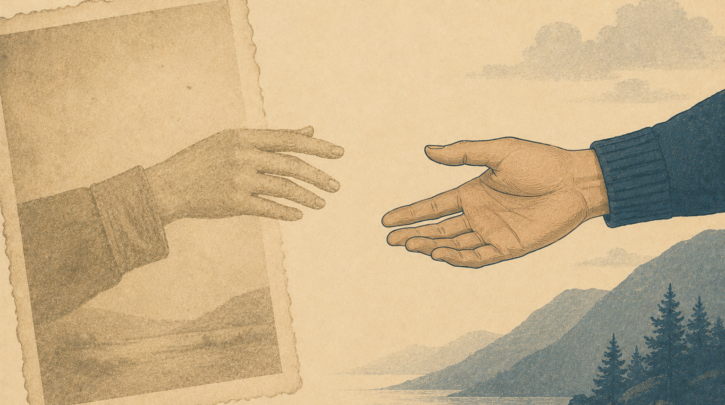

You do not need a Norwegian passport to be Norwegian in the ways that matter most. For the great majority of descendants who cannot claim citizenship, the far richer inheritance—your family’s history, the farm they came from, the living culture they carried—is entirely and unconditionally yours to reclaim. This final guide gathers the ways you can embrace your Norwegian heritage fully, from the records to the traditions, whether or not you ever set foot in Norway or hold any document at all.
Reclaiming your heritage asks no application, residence or passport—only interest and care. It is open to everyone with Norwegian roots, regardless of citizenship. See our honest guide to Norwegian heritage without citizenship.
Start with your family’s story
The foundation of reclaiming your heritage is knowing your family’s story. Trace your ancestors through Norway’s superb free records—name the people, find the farm, learn when and why they emigrated—and you turn a vague sense of Norwegian roots into a real, documented heritage you can hold and pass on. This knowledge is the root from which everything else grows: the traditions mean more when you know the people who kept them, and a heritage trip means more when you know whose farm you are visiting. Begin, as always, with the research.
Not sure where to start with your Norwegian ancestry?
Get the Norwegian Genealogy Quick-Start Checklist — a 5-step path to your first real ancestor record, plus the naming quirk that trips up almost everyone at first.
Bunad and syttende mai
Among the most joyful expressions of Norwegian heritage are the bunad and syttende mai. The bunad—the traditional folk costume, with regional designs tied to specific districts—is worn with pride for special occasions, and a bunad from your family’s own district is a beautiful and meaningful link to your roots. Syttende mai, the seventeenth of May, is Norwegian Constitution Day, celebrated across Norway and the diaspora with parades, costume and festivity—often more exuberantly in Norwegian America than in Norway itself. Taking part in syttende mai, wherever you are, is one of the simplest and most joyful ways to live your Norwegian heritage.
The food traditions
Few things carry heritage as warmly as food. Norwegian-American families kept alive dishes that became markers of identity, especially at Christmas: lefse (the soft potato flatbread), lutefisk (the famous—and famously divisive—dried cod), krumkake and rommegrot, and the national dish farikal. Learning to make these foods—perhaps from an older relative, or from a Norwegian-American community—is a delicious and sociable way to reclaim your heritage, and to pass it to the next generation. The kitchen is often where heritage lives most vividly, and where the generations connect over the same recipes your emigrant ancestors carried across the ocean.
The bygdelag and Sons of Norway
You need not reclaim your heritage alone: Norwegian-American community organisations exist to help. The bygdelag—associations of descendants from the same Norwegian home district—connect you with others who share your regional roots and often preserve knowledge and records of the very district your family came from. Sons of Norway, the large Norwegian-American fraternal organisation, has lodges offering culture, language, community and connection. Joining such organisations plugs you into a living Norwegian-American world, links you with others on the same journey, and can even aid your genealogy through their focus on specific home districts.
Stave churches, folk arts and music
Norwegian heritage is rich in distinctive arts and crafts you can appreciate and even learn. The stave churches—Norway’s remarkable medieval wooden churches, a unique architectural treasure—are a proud part of the heritage, whether seen in Norway or admired from afar. The folk arts include rosemaling (decorative flower-painting), traditional knitting, and the haunting music of the Hardanger fiddle (hardingfele), along with folk dance and song. Exploring these—taking a rosemaling class, learning to knit a traditional pattern, listening to Norwegian folk music—is a creative and absorbing way to connect with the culture your ancestors made and carried.
Learning the language
For a deeper connection, consider learning some Norwegian. You need not become fluent to benefit: even a little of the language brings you closer to your heritage, helps you read the older words in the records, enriches a heritage trip, and connects you with relatives in Norway. Many descendants find learning Norwegian a rewarding long-term project that keeps their heritage alive in daily life, and resources abound, from apps and classes to the language programmes of Sons of Norway. Whether you learn a few phrases or pursue real fluency, the language is a living thread back to the world your ancestors spoke in.
Connecting with Norway and your cousins
Finally, reclaim your heritage by connecting with living Norway. Reach out to the cousins you find through DNA and records, correspond with relatives in the ancestral district, follow Norwegian news and culture, and—when you can—make the heritage trip to see it all for yourself. Heritage is not only about the past but about a living relationship with the country and people your family came from. Building that relationship—across distance and generations—keeps your Norwegian roots not merely remembered but alive.
Your roots are yours
Whatever the citizenship answer, your Norwegian roots are unconditionally yours—in the family you can trace, the farm you can find and visit, the cousins you can meet, and the living traditions of costume, food, music, community and language you can take up and pass on. To reclaim your Norwegian heritage is not to obtain a document but to claim a birthright of history and belonging that no rule can grant or deny. Begin with the records, follow them home to the farm, and embrace the heritage that has been yours all along. Velkommen hjem—welcome home.