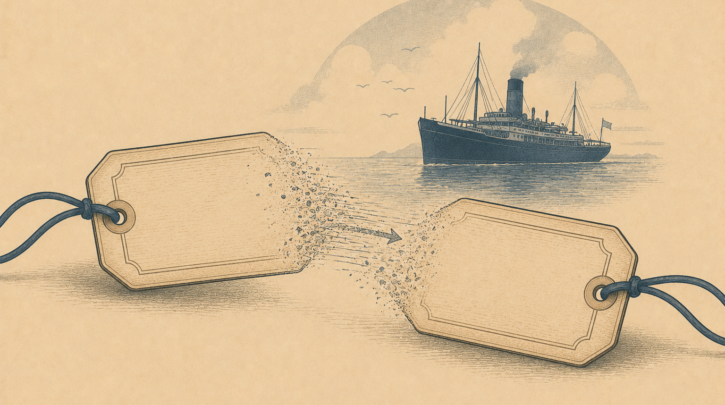

For the vast Norwegian-American diaspora, the family surname often looks quite different from the name the family used in Norway—and understanding how and why it changed is essential to tracing the family back across the ocean. On emigration, a fluid Norwegian name was frozen into a fixed American surname, and then that name was frequently respelled, simplified or even swapped. This guide explains the changes Norwegian surnames underwent in America, and—crucially—how to reverse them to recover the Norwegian original.
First, the name had to be fixed
The most fundamental change was that a fluid Norwegian name became a fixed American surname. In Norway, your ancestor may have carried a patronymic and a farm name—Ole Hansen Berg—neither of which was a permanent hereditary surname. On emigrating, the family had to settle on one fixed name for American life, and this freezing is the root of most Norwegian-American surnames. The family chose—or drifted into—one name and kept it, and their descendants carry it still. Understanding that your surname was fixed at emigration, from a name that was previously fluid, is the starting point for tracing it back.
Not sure where to start with your Norwegian ancestry?
Get the Norwegian Genealogy Quick-Start Checklist — a 5-step path to your first real ancestor record, plus the naming quirk that trips up almost everyone at first.
Patronymic or farm name?
The key question for any Norwegian-American surname is which element was frozen: the patronymic or the farm name. Some families kept the patronymic, so Ole Hansen Berg’s descendants became the Hansen (or Hanson) family. Others kept the farm name, becoming the Berg family. Which a family chose varied, though rural families often kept the farm name and others the patronymic. This matters enormously for research, because it tells you what your surname represents: a frozen patronymic points to an ancestor’s father’s given name, while a frozen farm name may point to the ancestral farm itself—a potential signpost home.
Anglicised spelling
Once fixed, Norwegian surnames were frequently respelled to suit American English and its alphabet. The distinctively Norwegian letters were the first to go: ø became o or oe (Sørensen to Sorensen or Sorenson), å became a or aa, and æ became ae or e. Double letters were sometimes simplified, and spellings drifted toward American phonetics. These changes can make a name look quite different on paper while sounding much the same, so when searching Norwegian records you must mentally restore the Norwegian letters—an American “Solberg” may be a Norwegian “Sølberg,” and so on.
-sen becomes -son
A specific and very common change affected the patronymic ending. The Norwegian -sen was often respelled -son in America, so Hansen became Hanson, Olsen became Olson, Pedersen became Pederson or Peterson. This drift, influenced by American spelling and by the naming of neighbouring immigrant groups, means a great many Norwegian-American families carry a -son name whose Norwegian original ended in -sen. When tracing such a family, remember to search the Norwegian records for the -sen form, since that is how the name will appear there, as noted in Norwegian patronymic surnames.
Translation, simplification and substitution
Some names underwent bolder changes. A few farm names were effectively translated or simplified into more American-sounding forms; long or difficult names were shortened; and occasionally a family adopted a quite different name for ease in their new country. Less commonly, a family that had used a patronymic in Norway adopted the farm name in America, or the reverse, so the American surname may not be the element you would expect. These bolder changes are less frequent than simple respelling, but they do occur, and they mean you should hold your assumptions about the Norwegian original loosely until the records confirm it.
Reversing the change
For the researcher, the goal is to reverse the changes and recover the name your family used in Norway. Work through the possibilities systematically: restore the Norwegian letters (o to ø, a to å), convert -son back to -sen, and consider whether the surname is a frozen patronymic (pointing to a father’s given name) or a frozen farm name (pointing to a place). Then test the reconstructed Norwegian name against the records. This detective work—undoing the Americanisation to find the original—is one of the characteristic tasks of Norwegian-American genealogy, and it is often the step that reconnects a family to Norway.
Turning the change into a clue
Handled well, the way a surname changed is itself a source of clues. A frozen farm name is a gift, potentially naming the very farm to search for in the records; a frozen patronymic hands you an ancestor’s father’s name; and the specific respellings can hint at when and how the family assimilated. Combined with the emigration records and the community’s clustering by home district, understanding the surname change is a key part of finding your emigrant ancestor—the thread that leads from an American surname back to a Norwegian farm.